Few creatures in Japanese folklore are as slippery as the kitsune. Depending on which story you read, the fox is a loyal messenger of the gods, a trickster who plays pranks on travellers, a devoted wife, or a demon capable of bringing down an emperor. Often it is several of these at once.
That ambiguity is exactly why the kitsune has stayed so popular: in shrines, in anime, and in tattoo studios. Here is what the fox actually means, and why the number of tails matters.
What is a kitsune?
Kitsune (狐) is simply the Japanese word for fox. In folklore, though, it describes something more: a fox with supernatural power that grows with age. Foxes lived close to people in rural Japan, hunting the rats that raided rice stores, so it is no surprise they became woven into farming life and belief.
Most stories give kitsune three main abilities: shapeshifting (very often into a beautiful woman), possession of humans, and kitsune-bi, or foxfire: ghostly lights seen floating over fields at night.
Why do kitsune have nine tails?
A kitsune's tails are a measure of its age, wisdom and power. The traditional telling is that a fox gains a new tail every hundred years or so. When it reaches nine tails, its fur turns white or gold and it gains something close to cosmic insight; some stories say it can see and hear anything happening in the world.
The nine-tailed fox (kyūbi no kitsune) is the most powerful form, and it is the one most people picture. The idea travelled to Japan from Chinese mythology, where the huli jing fox spirit plays a similar role, but Japan gave it its own personality.
Good fox, bad fox: zenko and yako
Japanese folklore splits foxes into two broad camps:
- Zenko (善狐): benevolent foxes, associated with Inari, the Shinto deity of rice, prosperity and business. They protect, bring luck and carry messages.
- Yako (野狐): "field foxes", the wild and mischievous kind. These are the tricksters who lead travellers astray, possess people or cause trouble just for fun.
This split is why a kitsune can be read as either a guardian or a warning. The meaning depends on the context and, in a tattoo or a graphic, on how the fox is drawn.
Kitsune and Inari shrines
Walk into almost any Inari shrine in Japan (and there are tens of thousands of them) and you will find a pair of stone foxes guarding the entrance. One often holds a key in its mouth (the key to the rice granary), the other a jewel or scroll. Worshippers leave offerings of aburaage, fried tofu, which is said to be the fox's favourite food. That is also where kitsune udon gets its name.
The most famous is Fushimi Inari Taisha in Kyoto, with its tunnels of thousands of vermilion gates climbing the mountain. If those gates interest you, we have written about what a torii gate means.
The darker side: Tamamo-no-Mae
The most notorious kitsune story is that of Tamamo-no-Mae, a courtesan of legendary beauty and intelligence at the court of Emperor Toba. When the emperor fell mysteriously ill, an onmyōji (court diviner) exposed her as a nine-tailed fox. She fled, was hunted down, and her spirit was sealed in a boulder: the Sesshō-seki, or killing stone, in Tochigi prefecture. The stone famously split in two in 2022, which made headlines around the world.
What does a kitsune symbolise?
Put together, the fox usually stands for:
- Intelligence and cunning: the ability to outthink rather than overpower.
- Transformation: shapeshifting as a metaphor for growth and reinvention.
- Protection and prosperity: through the link with Inari.
- Duality: the knowledge that the same being can help or harm.
Kitsune in tattoo art
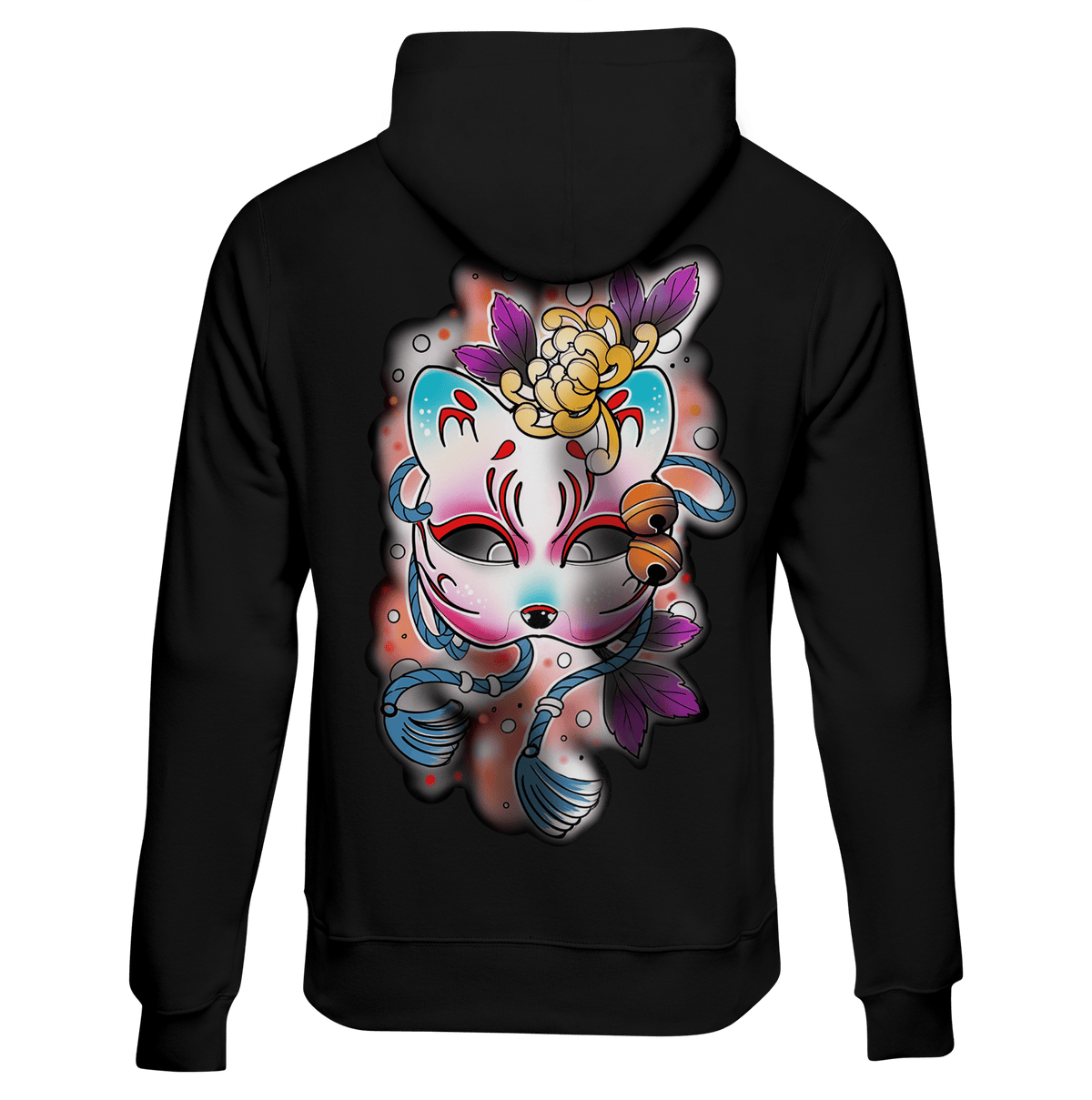
The fox is a staple of irezumi, traditional Japanese tattooing. Artists use the number of tails, the expression and surrounding elements (flames, maple leaves, a fox mask) to steer the meaning towards guardian or trickster.
That tradition is the starting point for our KITSUNE t-shirt and KITSUNE hoodie, a collaboration with British tattoo artist Kishosumi, who specialises in Neotraditional and traditional Japanese irezumi. It is tattoo-grade linework you can wear without committing to the needle. Other yokai and demons are in oni, akuma and yōkai explained.
Frequently asked questions
Are kitsune good or evil?
Both. Zenko, linked to Inari, are benevolent; yako are mischievous or malicious. Most stories sit somewhere in between.
What does a kitsune mask mean?
Fox masks appear at festivals and Inari shrines and are linked to the fox as a messenger between the human and spirit worlds. Worn today, they usually signal mystery, playfulness or a hidden identity.
Is the nine-tailed fox Japanese or Chinese?
The idea originated in Chinese mythology and spread to Korea (the kumiho) and Japan, where it developed its own distinct stories.
What does a kitsune tattoo mean?
Commonly intelligence, transformation and protection, or a nod to your own trickster side. The number of tails usually signals wisdom and power.
Wear the fox
Browse the full NEOMACHI range for more designs rooted in Japanese myth, or read why cyberpunk is so Japanese.
New to NEOMACHI? Sign up to our emails and get 15% off your first order.