Fujin and Raijin meaning, in one line: Fūjin (風神) is the Japanese god of wind and Raijin (雷神) is the god of thunder and lightning, a pair of fierce, horned weather deities who are almost always shown together, one hauling a bag of winds, the other beating a ring of drums. They started life as demons, ended up as temple guardians, and became two of the most painted, carved and tattooed figures in Japanese art.
Here is who they are, where they come from, why they come as a set, and why a wind god and a thunder god ended up on our hoodies.
Who are Fujin and Raijin?
The names are as literal as Japanese gets. 風 (fū) means wind and 神 (jin, also read kami) means god, so Fūjin is simply "wind god". 雷 (rai) means thunder, so Raijin is "thunder god". Raijin goes by plenty of other names too, most commonly Kaminari-sama (Mr Thunder) and Raiden-sama.
- Fūjin, the wind god: usually green-skinned, horned and grimacing, with claw-like hands and feet. He carries a huge bag slung over his shoulders and lets the world's winds out of it, from a breeze to a typhoon.
- Raijin, the thunder god: usually red, horned and wild-haired, standing on a cloud inside a ring of drums marked with tomoe (comma-shaped swirls). He beats them with hammers or drumsticks, and the noise is the thunder.
They look like oni, the horned demons of Japanese folklore, and that is not an accident. If you want the full family tree of demons and spirits, our guide to oni, akuma and yōkai sorts it out.
Where Fujin and Raijin come from
A journey along the Silk Road
Fūjin and Raijin are not purely Japanese inventions. Scholars trace them back through Buddhism to Indian weather deities and to the Chinese wind and thunder gods. Some of the earliest known images of the pair are in sixth-century cave paintings at Dunhuang in western China, on the old Silk Road. Some art historians even connect the wind god's billowing cloth to Greek images of Boreas, the north wind, carried east along those same trade routes.
From demons to protectors
In Japan's earliest surviving depiction, an eighth-century illustrated sutra, the two are among the demons trying to frighten the Buddha. Over the following centuries they switched sides. They became part of the 28 attendants of the thousand-armed Kannon, and the famous 13th-century wooden statues at Sanjūsangen-dō in Kyoto show them flanking those ranks of golden Kannon figures, protecting rather than attacking. Today they are classic gate guardians: the giant red lantern of Kaminarimon, the "Thunder Gate" at Sensō-ji in Asakusa, Tokyo, hangs between statues of Fūjin and Raijin.
The Shinto side of the story
In Shinto myth, thunder has darker roots. In the Kojiki, Japan's oldest chronicle, the god Izanagi follows his dead wife Izanami into the underworld and finds thunder deities born on her decaying body, who then chase him out. Thunder later became linked with Sugawara no Michizane, a Heian-era scholar exiled unjustly, whose angry spirit was said to strike the capital with lightning until he was honoured as a god.
Why are Fujin and Raijin always together?
Because a storm needs both. Wind and thunder arrive together, and the two gods are often described as brothers, sometimes rivals, always a pair. Japanese art plays with that tension: they face each other, chase each other or squabble across the sky.
The most famous example is the Fūjin Raijin-zu folding screens painted by Tawaraya Sōtatsu in the early 17th century, owned by Kennin-ji temple in Kyoto and designated a National Treasure. Sōtatsu put the green wind god on one panel, the white thunder god on the other, and left a vast field of gold leaf between them. That empty space is the point: you feel the storm in the gap. Ogata Kōrin later painted his own homage to the screens, now in the Tokyo National Museum, and the image has been copied, remixed and referenced ever since.
What do Fujin and Raijin symbolise?
- The raw power of nature. Before weather forecasts, typhoons and lightning were the most violent forces anyone would see. Fūjin and Raijin give that power a face.
- Harvest and luck. Storms bring rain, and rain grows rice. One Japanese word for lightning, inazuma (稲妻), literally means "rice wife", from the old belief that lightning helped the rice ripen.
- Protection. As temple guardians, their fierce faces are aimed at whatever is trying to get in, not at the people walking through the gate.
- Balance. Two opposing but matched forces, which is why they work so well as a pair in tattoos and on clothing.
There is also a bit of everyday folklore that most Japanese kids know: during a thunderstorm, cover your belly button, or Kaminari-sama will steal it.
Fujin and Raijin in tattoos and pop culture
Both gods are staples of irezumi, traditional Japanese tattooing, often as a matching pair across the back or on two sleeves. Our irezumi tattoo guide explains how motifs like these are chosen and combined. In games, the thunder god Raiden of Mortal Kombat borrows his name from Raijin's, and wind and thunder deities turn up all over JRPGs and anime. The look of the pair, muscles, horns, flying cloth and swirling clouds, is basically the original Japanese action pose.
For more figures like these, from kitsune to torii gates, see our guide to Japanese symbols and meanings, or meet two of Japan's holy beasts in our guides to the kirin and the Japanese phoenix.
Why the wind and thunder gods fit cyberpunk
Cyberpunk loves old power plugged into new circuitry. A thunder god is a figure who literally commands electricity, and a wind god who carries a storm in a bag is not far from someone carrying a power cell. Put them in electric colours and sharp linework and they look less like museum pieces and more like characters from a neon city. That mix of ancient Japanese myth and future-city energy is a big part of why cyberpunk is so Japanese in the first place.
Wearing the gods: our FUJIN and RAIJIN designs
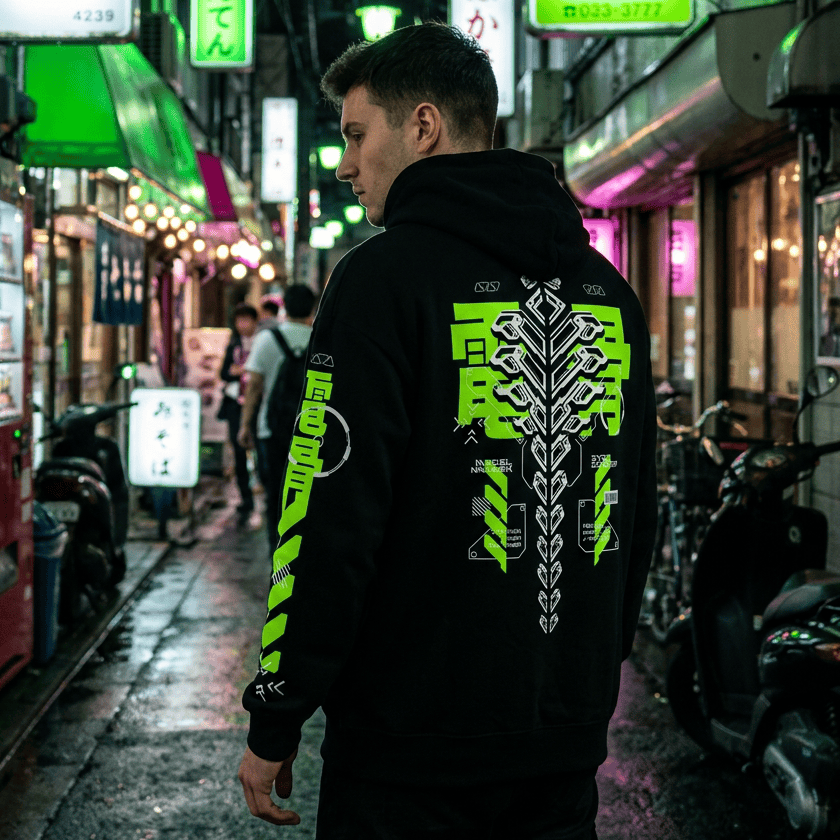
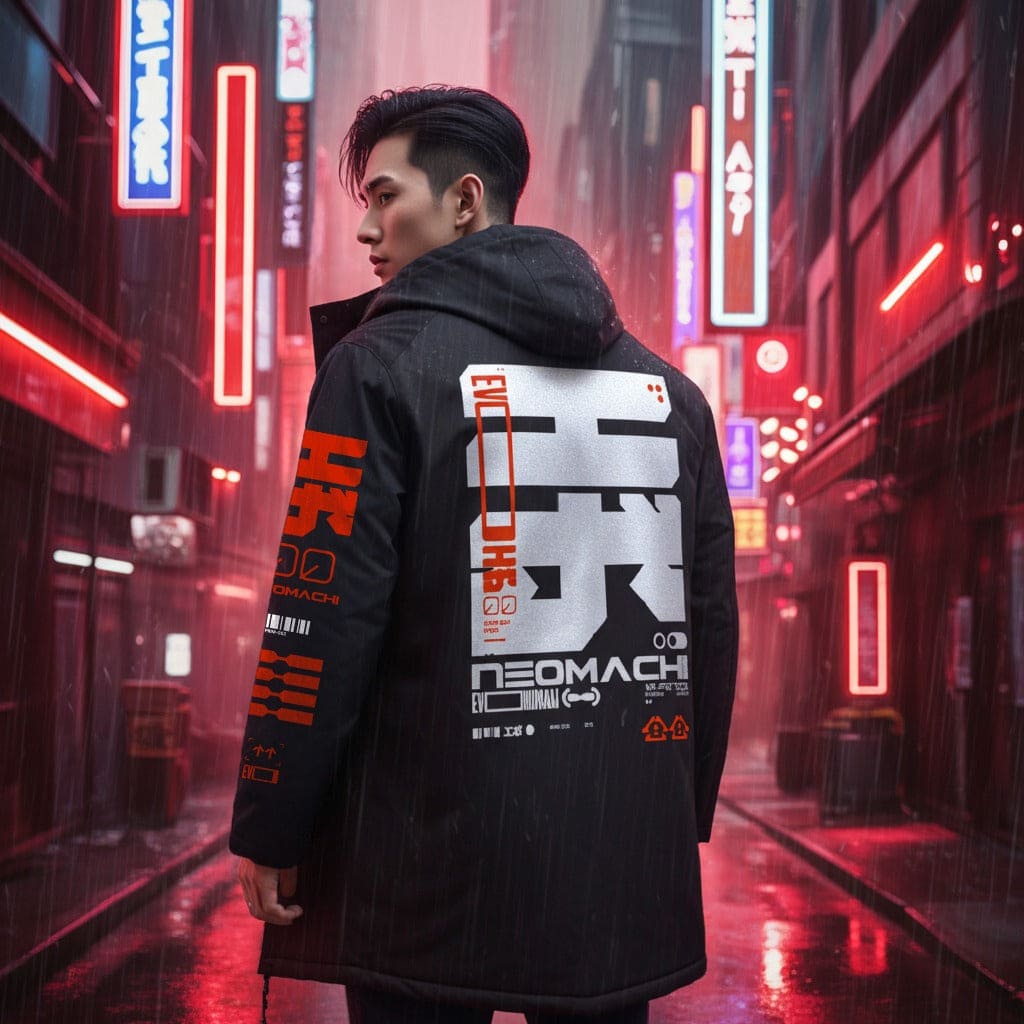
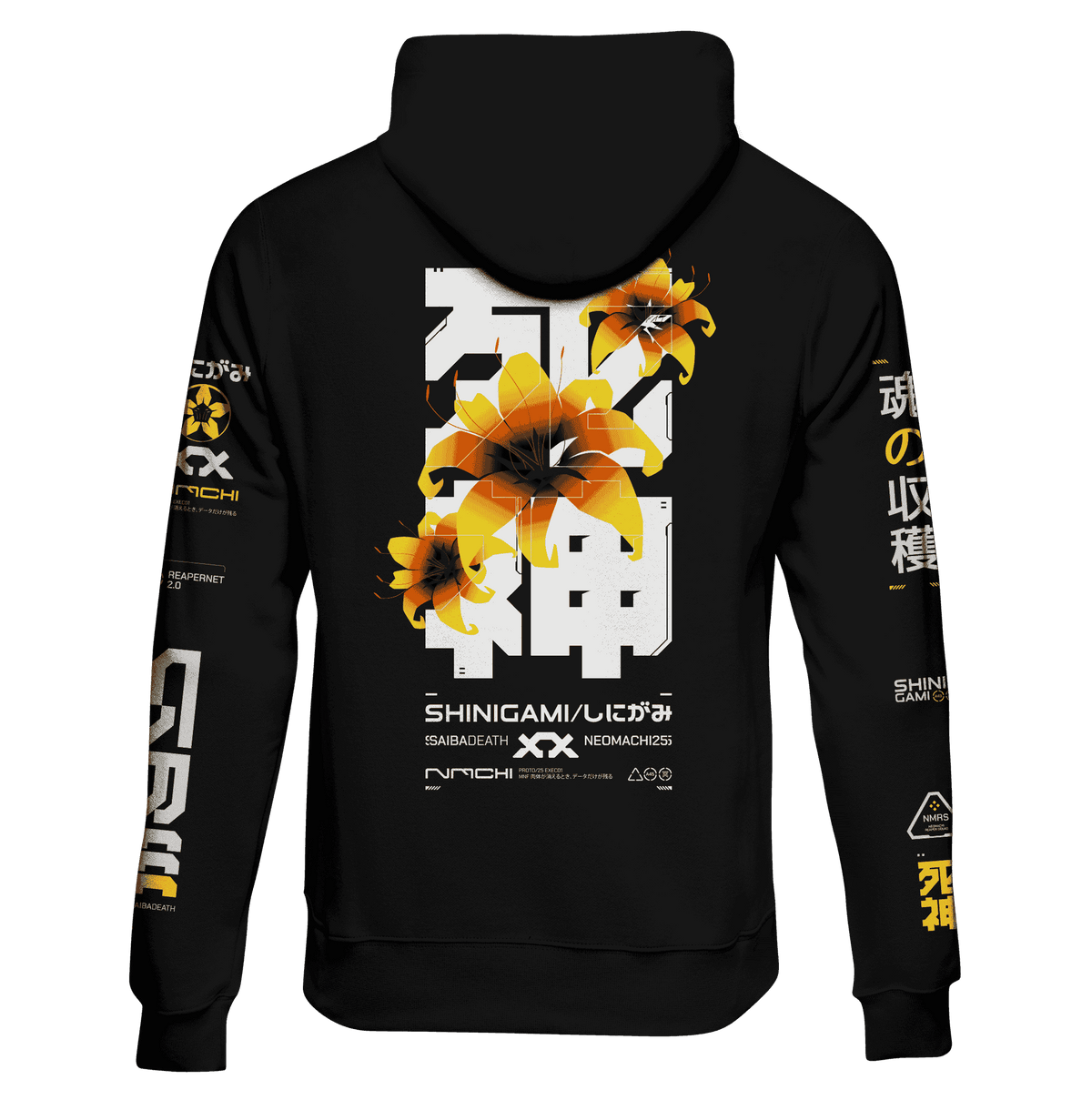
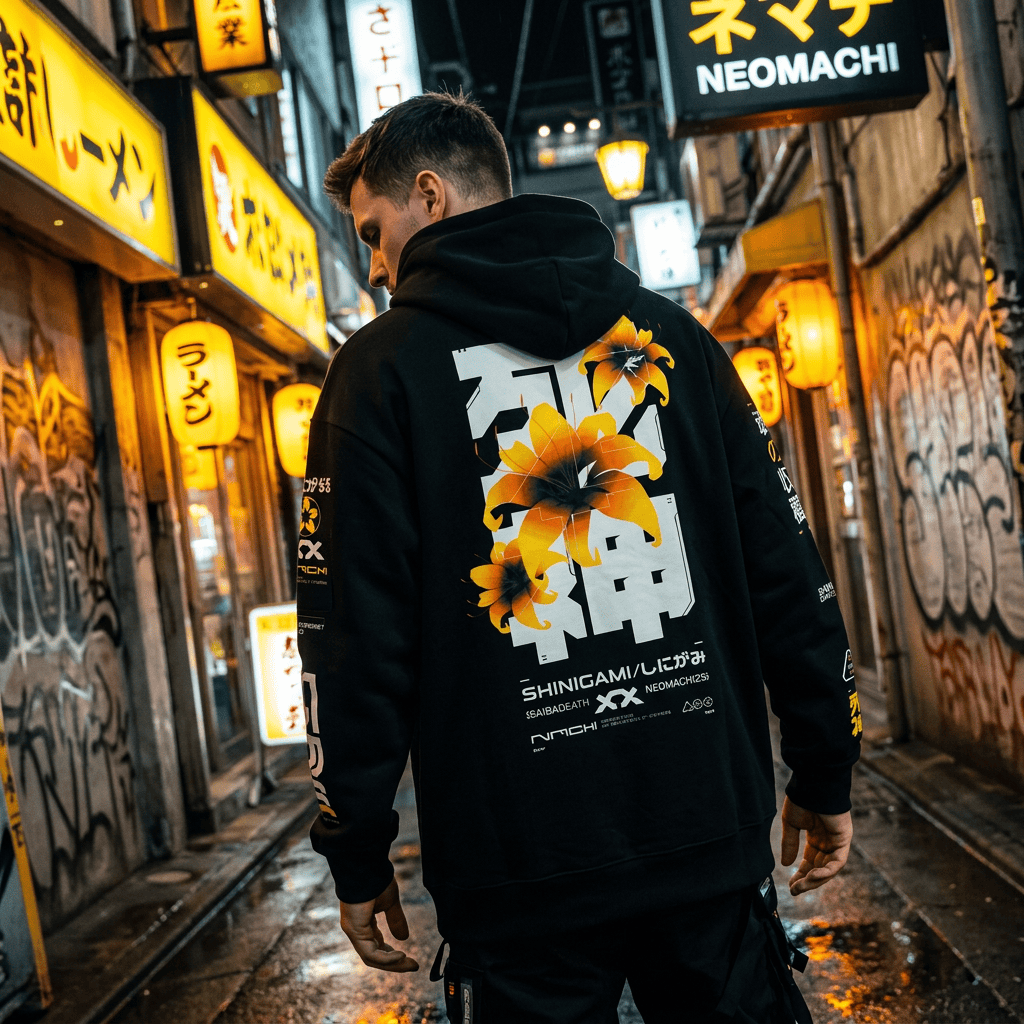
We drew the pair as two separate designs, so you can wear one, or split them between two people the way Sōtatsu split them across two screens. Both keep the classic character of each god, placed in vivid electric colour.

- FUJIN hoodie and RAIJIN hoodie: B&C Inspire Hooded, 280 GSM, 80% organic cotton with a 20% recycled polyester fleece lining. True to size and slim, so size up for a baggier fit (our hoodie fit guide has the measurements).
- FUJIN t-shirt and RAIJIN t-shirt: Stanley/Stella Creator 2.0 organic cotton in a medium unisex fit.
- FUJIN sweater and RAIJIN sweater: fitted, so size up if you like room to layer.

Want the whole storm? Add the SUSANOO hoodie, the storm god of Shinto myth, or browse all our cyberpunk hoodies, cyberpunk t-shirts and cyberpunk sweaters for more mythology-meets-cyberpunk clothing.

Frequently asked questions
What is the difference between Fujin and Raijin?
Fūjin is the god of wind and carries a bag of winds; Raijin is the god of thunder and lightning and beats a ring of drums. Fūjin is usually painted green, Raijin red or white.
Are Fujin and Raijin brothers?
They are often described as brothers, and sometimes as rivals. Either way they are treated as a pair, because wind and thunder come together in a storm.
Are Fujin and Raijin good or evil?
Both. In early Buddhist art they appear among demons attacking the Buddha, but in Japan they became protectors and temple guardians. Their storms can destroy, and they also bring the rain that grows the rice.
Where can you see Fujin and Raijin in Japan?
At Sanjūsangen-dō in Kyoto (13th-century wooden statues), at Kaminarimon, the Thunder Gate of Sensō-ji in Asakusa, Tokyo, and in Sōtatsu's folding screens, which belong to Kennin-ji in Kyoto.
Why does Raijin have drums?
The drums are the thunder. Raijin beats them to make the sound of the storm, which is why he is shown inside a ring of drums marked with tomoe swirls.
All NEOMACHI designs are original artwork inspired by Japanese mythology and art history. Designed in Amsterdam, printed in Europe.