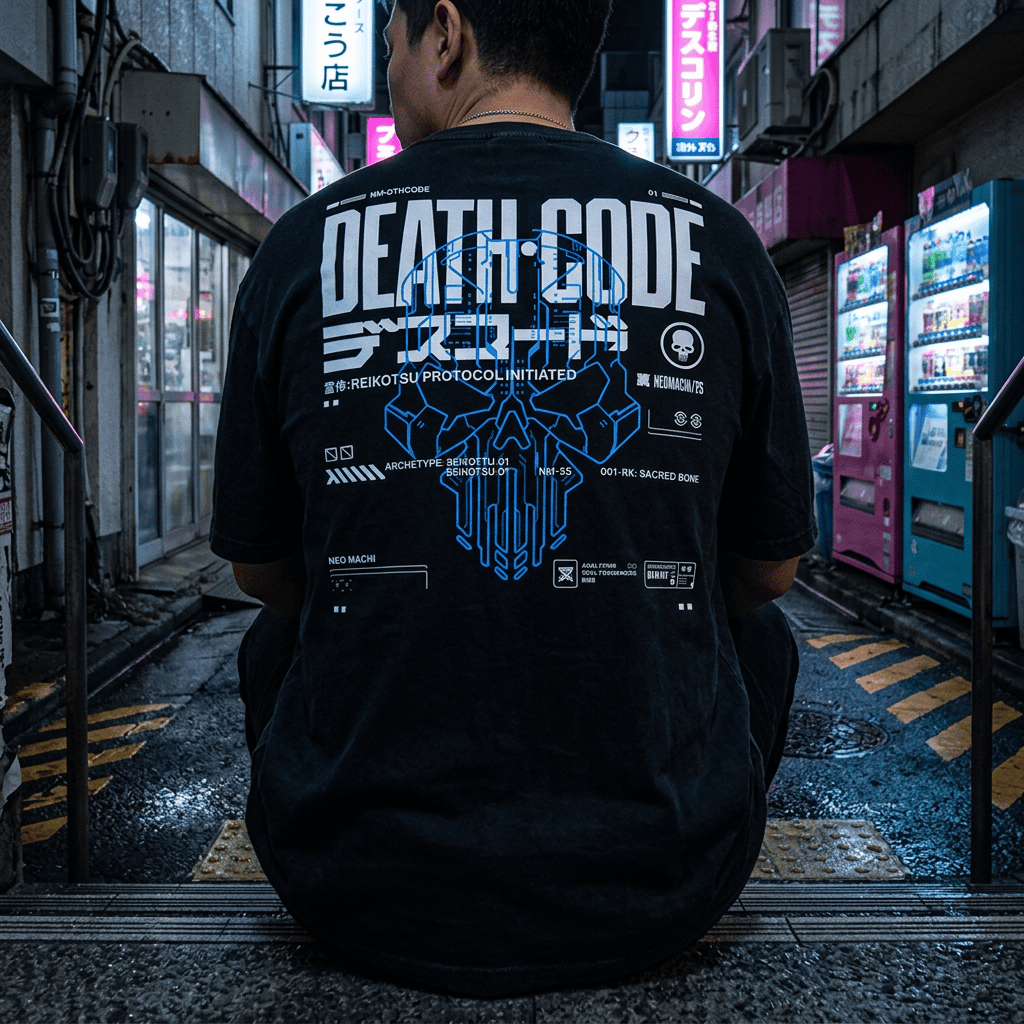
A hoodie is the piece you will wear more than anything else you own, which makes it the worst place to save fifteen euros and the best place to wear something that means something. Cheap ones announce themselves within a season: the print cracks, the body shrinks, the black fades to an exhausted grey. Thoughtless ones last longer but say nothing.
This guide covers both halves of the decision. First the motif, because a samurai, an oni and a mecha are not interchangeable and the person wearing one usually knows it. Then the things that decide whether the hoodie is still in rotation in four winters: fabric, print placement, fit and care.
Quick guide
| Motif | What it stands for | Best for | Start here |
|---|---|---|---|
| Samurai | Discipline, loyalty, craft: the Bushido code | The one who trains, studies or builds | 5AMUR41, SAMURAITAIGĀ |
| Oni | Japan's demon: wild, horned, outside human order | The one who wears black and means it | ONI, AKUMA |
| Shinigami | The death spirit and the spider lily: life, death, rebirth | The one who reads the lore | SHINIGAMI |
| Mecha | The Gundam tradition: armour as machine, samurai spirit underneath | The gamer, the engineer | MECHA |
| Kitsune | The fox spirit of Japanese folklore, drawn by a tattoo artist | The one who likes irezumi | KITSUNE |
| Kaiju | The monster from the sea, the anime generation's icon | The anime fan | GOJIRA |
Pick the motif
Every design in the hoodie collection is drawn by our own artists around a figure from Japanese folklore, history or pop culture, and then pushed forward into a cyberpunk register. Here is what the recurring figures mean, in the plainest version we can give without pretending to be a folklore department.
Samurai
The warrior class of feudal Japan, and more usefully the code attached to it: Bushido, the way of the warrior, built on discipline, loyalty, honour and craft. It is the most-searched motif in this category for a reason. It reads as intent rather than aggression. 5AMUR41 rewrites the code in ones and zeros; SAMURAITAIGĀ pairs the samurai with the tiger, two symbols of focus in one composition.
Oni
The oni is Japan's demon or ogre: massive, horn-crowned, a force from outside the boundaries of civilised life. Not simply evil, but wild. In festivals the oni is the thing you drive out of the house each spring; on a hoodie it is the thing you have decided to wear on purpose. ONI renders the mask with futuristic framing. AKUMA, the more general word for a demon, is its darker sibling.
Shinigami
Shinigami are death spirits, a figure that entered Japanese folklore comparatively recently and has been carried around the world by manga and anime. The spider lily that goes with it blooms at the boundary between worlds and grows around graveyards, which is why it stands for the cycle of life, death and rebirth rather than for death alone. SHINIGAMI combines the flower with the kanji 死神 and sharp cyberpunk detailing.
Mecha
Not folklore but its modern successor: the giant piloted robot of anime, a tradition that runs from Mobile Suit Gundam in 1979 to today. The armour is machine; the pilot inside still carries the samurai's willingness to face something larger and not flinch. MECHA gives you the weight of the suit, dynamic colour and lightning as punctuation.
Kitsune
The fox spirit, a shapeshifter and messenger in Japanese folklore, and one of the most-loved figures in traditional tattoo art. KITSUNE is a collaboration with British tattoo artist Kishosumi, who specialises in traditional and neotraditional Japanese irezumi and drew the mask exclusively for NEOMACHI. If you like tattoo art but not the commitment, this is the one.
Kaiju and the rest
The kaiju, the monster from the sea, is the anime generation's icon, and GOJIRA is our version of it. Beyond these, the collection covers dragons (OROCHI), wolves (ŌKAMI), kabuki (KABUKI) and the technical designs like SYSTEM 7 and EVO for people who prefer schematics to spirits. How to read the katakana, kanji and faction marks on the graphics is a subject of its own: cyberpunk graphics explained.
Pick the fabric
Fabric weight is measured in gsm, grams per square metre, and it is the single most predictive number for how a hoodie feels and how long it lasts. Under 250 gsm is a layering piece that will not hold its shape. 280 to 350 gsm is the year-round sweet spot: enough body to drape, not so heavy it becomes a coat. Above 400 gsm is winter-specific and hot indoors.
Ours is a B&C Inspire blank at 280 gsm: 80% organic ring-spun combed cotton, 20% recycled polyester in the brushed fleece lining. The organic cotton is GOTS-accredited and the blank is Fair Wear Foundation certified, OEKO-TEX Standard 100 and PETA-approved vegan. The 4XL and 5XL sizes use a Stanley/Stella Drummer hoodie, because the B&C stops at 3XL. Full details are on the hoodie garment information page.
Why organic and not just cotton: organic fibre tends to be longer-staple, which means a smoother surface, less pilling and better print definition. The certification and what it actually covers is explained in our piece on GOTS and organic cotton streetwear, and the broader reasoning in why we use sustainable materials.
Pick the print
Placement tells you more about a hoodie than the method does. A front print only is a blank with a decoration. Artwork that continues down the sleeve or across the full back was designed as a garment, and it costs meaningfully more to produce, which is why almost no dropshipper does it.
- Back print. The largest canvas and the one most of our designs are drawn for. The chest carries a small mark; the back carries the story. Most of the hoodie collection works this way.
- Sleeve print. Artwork running down one or both arms in addition to the back. The fully committed version, priced from €75 rather than €65 because there is more of it. OROCHI, ŌKAMI, KABUKI and EVO are sleeve-printed.
- Zip hoodie. Same blank, opens at the front. More forgiving on fit, layers over a printed tee, and the better choice if you are buying for someone else. Zip hoodies are €78.
- Sweatshirt. No hood, cleaner line, easiest to size. Most designs exist as a sweater at €59.
Pick the fit and size
Our hoodies are a slim, fitted cut that fits true to size. Take your normal size for that silhouette; size up only if you prefer a relaxed or oversized look. Do not size up by default, and do not rely on the letter: measure a hoodie you already own and like, chest width flat and body length from the shoulder, then compare with the hoodie size guide. Every measurement from XS to 5XL is listed.
If the design is a zip hoodie or a sweatshirt, the same measurements apply but a half-size error matters less. If you are buying a gift and do not know the size, that is the argument for the zip hoodie, or for the gift guide. One customer put the result better than we can: "My third Neomachi hoodie. I love how the quality seems to be getting better each time."
Care: how to wash a printed hoodie
- Wash inside out, cold, 30°C. Protects the print and stops black fading.
- Do not tumble dry. Heat cracks prints and shrinks cotton. Air dry flat.
- Never iron the print. Iron around it, or inside out on low.
- Wash less than you think. An outer layer does not need washing every wear. Air it.
Follow those four and a good hoodie stays good for years rather than months. Most print damage is heat damage, not wear.
Not sure which size to take? Our hoodie fit guide shows how a hoodie should fit and how to measure one.
Frequently asked questions
What does the samurai hoodie mean?
The samurai stands for Bushido: discipline, loyalty, honour and craft. On a cyberpunk hoodie it reads as intent, the warrior's code carried into a world where the battlefield looks different. 5AMUR41 and SAMURAITAIGĀ are our two takes on it.
What is an oni hoodie?
A hoodie built around the oni, the horned demon of Japanese folklore that represents everything outside the boundaries of civilised life. Ours renders the oni mask in graphic form with futuristic framing, in black, as a pullover, zip hoodie, sweatshirt or premium bomber.
How heavy should a good hoodie be?
Between 280 and 350 gsm for a hoodie you will wear year-round. Ours are 280 gsm with a brushed fleece lining. Below 250 gsm is a layering piece; above 400 is a winter piece that is uncomfortable indoors.
How do I wash a hoodie with a back print?
Inside out at 30°C, no tumble dryer, never iron directly on the print. Air dry flat. Those three rules prevent almost all cracking, which is heat damage rather than wear.
Do NEOMACHI hoodies run small?
No. They are a slim, fitted cut that fits true to size. If you prefer a relaxed silhouette, take one size up; otherwise take your normal size and check the chest measurement against the size guide.
Our range
Every NEOMACHI hoodie is drawn by real artists, not algorithms, printed in Europe on GOTS-accredited organic cotton, with measurements published from XS to 5XL. Buy two and add a tee to your cart for free.
Shop cyberpunk hoodies | Zip hoodies | How to style a techwear hoodie