Hachiman meaning: Hachiman (八幡, "eight banners") is the Japanese god of war and archery, and the divine protector of Japan and of the samurai. He is usually identified with the deified Emperor Ōjin, and with some 25,000 shrines he is one of the most widely worshipped kami in the country.
If you have ever walked through a Japanese town and passed a shrine with "Hachiman" on the gate, you have met him. He is not a distant god from an old book. He is the neighbourhood kami of half of Japan, the patron of the warrior class that ran the country for seven centuries, and the reason our HACHIMAN design looks like it is about to go to war. Here is who he is, where he came from and what his symbols mean.
Who is Hachiman?
Hachiman is a kami, a Shinto deity, best known as the god of war, archery and martial skill. That is only half the job description, though. He was also worshipped as a protector of the nation, of farming and of fishing communities, and a god of divination: someone you asked for guidance before you acted, not just strength while you fought.
He started as a local deity in northern Kyushu. His first formal shrine, Usa Jingū, was founded in 725, and from there his cult grew faster than almost any other in Japanese history. Today there are around 25,000 Hachiman shrines across Japan, which puts him in the same league as Inari, the fox-attended rice god from our kitsune guide.
What does Hachiman mean?
The name is written 八幡: hachi (八, eight) and man (幡, banner or flag). So Hachiman literally means "eight banners". The usual explanation is a legend that eight heavenly banners appeared at the birth of Emperor Ōjin, the ruler later identified with the god. The same characters can also be read Yawata, which is why you will see towns and stations called Yawata all over Japan.
Hachiman and Emperor Ōjin
Over time Hachiman was linked to Emperor Ōjin, a semi-legendary ruler traditionally dated to the late third and early fourth century. The first known text making that link dates from around 840. Ōjin's mother, Empress Jingū, also became part of the story: she was credited with a legendary military campaign to Korea while pregnant with him, which made the pair a natural fit for a god of war.
That is why Hachiman shrines often honour a trio: Ōjin, his mother Jingū, and a third deity, Himegami. It is also why Hachiman had such a strong link to the imperial family. Iwashimizu Hachimangū, built in 859 just south of the old capital Kyoto, became one of the most important shrines in the country.
Hachiman, Buddha and bodhisattva
Hachiman is one of the best examples of how Shinto and Buddhism blended in Japan. He was one of the first kami to be given a Buddhist title. In 937 he was officially recognised as a bodhisattva, and he was widely worshipped as Hachiman Daibosatsu, the Great Bodhisattva Hachiman. For centuries his shrines had Buddhist temples attached, and monks and priests served the same god side by side.
That mix is part of why he is so hard to pin down. Warrior god, ancestor emperor, protector of farmers, Buddhist saint: Hachiman is all of them at once.
Why is Hachiman the god of the samurai?
The short answer: the Minamoto clan. In the eleventh century the Minamoto, one of the great warrior families, adopted Hachiman as their patron and claimed descent from Emperor Ōjin. The famous warrior Minamoto no Yoshiie came of age at Iwashimizu and was nicknamed Hachiman Tarō, "Hachiman's firstborn son".
When Minamoto no Yoritomo founded the first shogunate at Kamakura, he moved the family's Hachiman shrine into the heart of his new capital in 1191. Tsurugaoka Hachimangū is still the centre of Kamakura today. Because the Minamoto were the first warrior rulers of Japan, their god became the god of the whole samurai class. Warriors prayed to Hachiman before battle, and he became tied up with the ideals you can read about in the seven virtues of bushido.
When Mongol fleets attacked Japan in 1274 and 1281, prayers went up at shrines across the country, Hachiman's among them. Both fleets were wrecked by storms, the kamikaze or "divine winds", and many in Japan credited the gods. For a storm god's side of that kind of story, see Fūjin and Raijin.
Hachiman symbols: bow, dove and tomoe
If you want to recognise Hachiman in art, a tattoo or a shrine, look for these:
- The bow and arrow. His main symbol. Hachiman is the god of archery, the original samurai skill, long before the sword took over. Shrines across Japan still sell hamaya, "demon-breaking arrows", as New Year protection charms.
- The dove. Doves (or pigeons) are Hachiman's messengers. That is why you will see them on shrine charms and why so many doves gather at Hachiman shrines. Not exactly the peace symbol you would expect from a war god.
- The mitsudomoe. The three-comma swirl (三つ巴) is the crest used at many Hachiman shrines and on the drums and roof tiles you see there.
- The torii. Every Hachiman shrine starts with one; we explain why in what a torii gate means.
Is Hachiman good or evil?
Good, firmly. Unlike tricksters such as the kitsune or wild forces like Japan's dragons, Hachiman is a protector. He is a war god, but in the sense of defending home, family and country rather than glorifying slaughter. Most visitors to his shrines today ask for protection and success, not victory in battle.
Hachiman vs Susanoo vs Raijin: which god is which?
Japanese gods are easy to mix up, especially in anime and games, so here is the quick version:
- Hachiman: god of war and archery, protector of Japan and the samurai. Calm, disciplined, worshipped everywhere.
- Susanoo: the storm god and brother of Amaterasu, wild and violent, slayer of the eight-headed serpent Orochi.
- Raijin and Fūjin: the gods of thunder and wind, drum-beating and bag-carrying, usually shown as fierce oni-like figures.
Hachiman is the general. The others are the weather.
Hachiman in cyberpunk: why a war god fits the neon city
Cyberpunk is full of street samurai, corporate armies and lone fighters with a code. A war god who is also a god of wisdom and divination fits that world perfectly: someone who thinks before he strikes. That is exactly the tension behind our design.

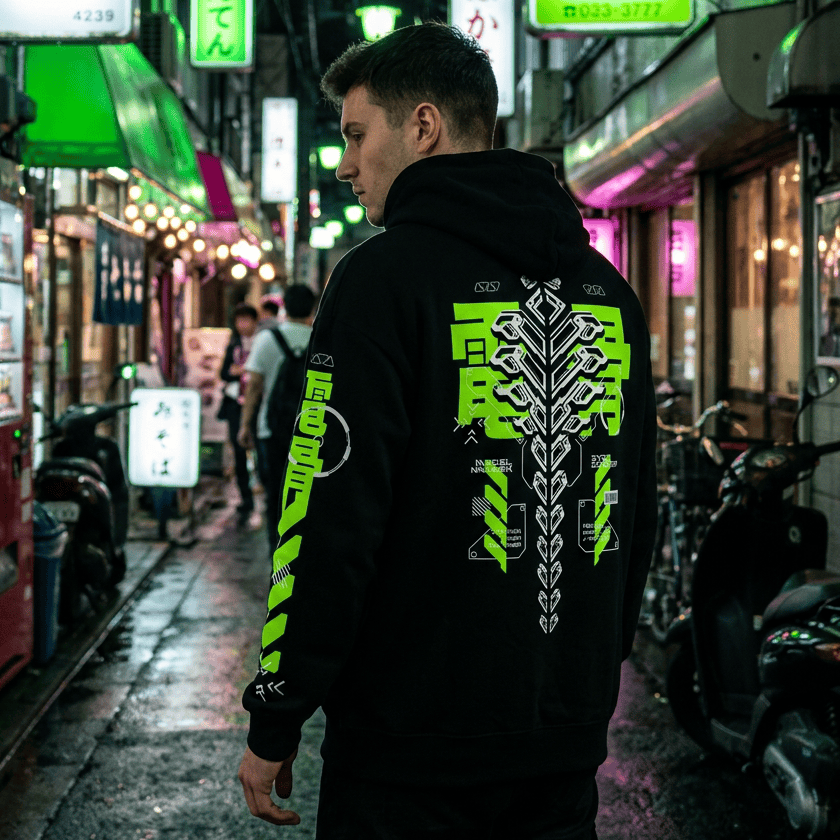
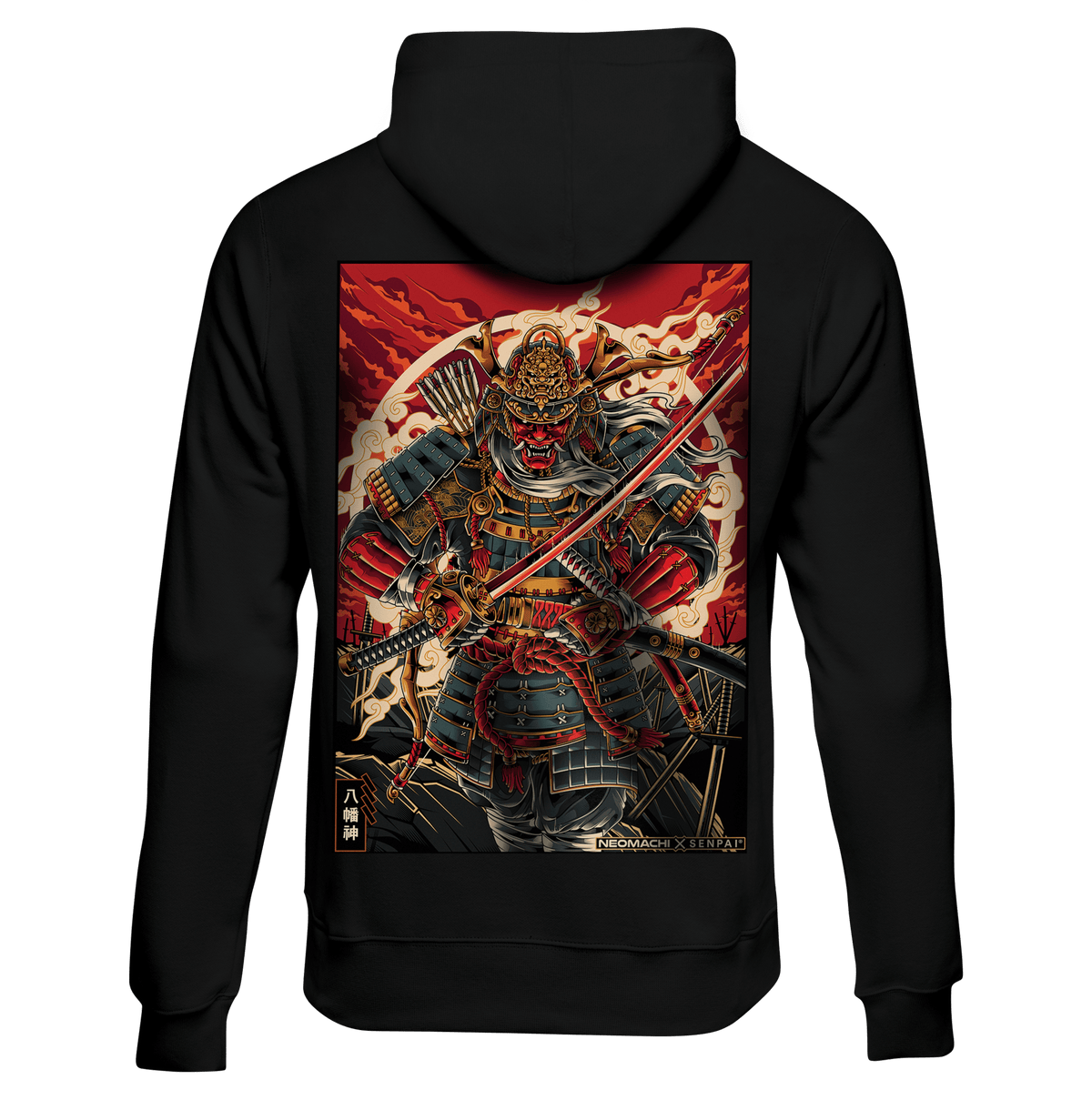
The HACHIMAN hoodie puts the war god into graphic form on a black hoodie, and it also comes as a HACHIMAN t-shirt in black, white and navy. The HACHIMAN 2.0 t-shirt keeps the mythology on the back and adds the classic logo on the front.

If you like the warrior side, the SAMURAITAIGĀ hoodie and SAMURAISHA t-shirt go well with it, and our guide to the cyberpunk samurai look shows how to wear the theme every day. For the full line-up of gods and monsters, browse our cyberpunk hoodies and cyberpunk t-shirts. The hoodies are slim and true to size, so check how a hoodie should fit if you want the oversized look.
Frequently asked questions
What is Hachiman the god of?
Hachiman is the Japanese god of war and archery, and a protector of Japan, the imperial family and the samurai. He is also linked to divination, farming and fishing.
What does Hachiman mean in Japanese?
八幡 means "eight banners", from a legend of eight heavenly banners at the birth of Emperor Ōjin. The same characters can be read Yawata.
Who is Hachiman in Japanese mythology?
He is a kami usually identified with the deified Emperor Ōjin, first worshipped at Usa in Kyushu. He later became the patron god of the Minamoto clan and the samurai, and was also honoured as a Buddhist bodhisattva.
What animal is the messenger of Hachiman?
The dove (or pigeon). Doves are Hachiman's sacred messengers, which is why they appear on charms at his shrines.
Where is the most famous Hachiman shrine?
Usa Jingū in Ōita is the original head shrine. Iwashimizu Hachimangū near Kyoto and Tsurugaoka Hachimangū in Kamakura are the other two big names.
Carry the banner
Hachiman is the god Japan's warriors trusted most: disciplined, protective and very much still around. For more of the symbols behind our designs, start with our Japanese symbols and meanings guide, read the story of the 47 ronin, or browse the full range of cyberpunk clothing.