On a clear winter morning, Mount Fuji is visible from the skyscrapers of Tokyo, around a hundred kilometres away. It appears on banknotes, stamps, sake labels, bathhouse walls and countless tourist photos. No other single image stands for Japan quite like it.
But Fuji is not just a pretty volcano. For centuries it has been a goddess, a pilgrimage, a lucky omen and an artistic obsession. Here is why it matters so much.
The basics
At 3,776 metres, Fujisan is Japan's highest mountain. It is an active stratovolcano: its last eruption was in 1707, known as the Hōei eruption, which dusted Edo in ash. Its near-perfect symmetrical cone is what makes it so instantly recognisable.
In 2013, UNESCO listed it as a World Heritage Site, notably as a cultural site rather than a natural one, under the title "Fujisan, sacred place and source of artistic inspiration". That title sums up the rest of this article.
A sacred mountain
In Shinto belief, mountains are often the homes of kami, and Fuji is the greatest of them. The mountain is associated with Konohanasakuya-hime, the goddess of blossoms and volcanoes, enshrined at Fujisan Hongū Sengen Taisha at its base. Worship of the volcano was partly about calming it: honouring the deity to keep eruptions away.
Buddhists came to see it as sacred too, and by the medieval period ascetic monks were climbing it as a spiritual practice.
Pilgrims and mini-Fujis
In the Edo period, climbing Fuji became a mass movement. Religious associations called Fuji-kō organised pilgrimages for ordinary townspeople, who would climb in white robes to the summit.
Not everyone could make the journey, so people built fujizuka, miniature Fujis made of lava rock brought from the mountain, in shrine grounds around Edo. Climbing one was believed to bring the same blessing. Several still stand in Tokyo today.
Women were officially barred from the summit until 1872. Today around two hundred thousand people climb each summer, during the official season from July to early September, many timing their ascent to watch sunrise from the top: goraikō.
The luckiest dream
In Japan, the first dream of the new year, hatsuyume, is said to predict your fortune. The luckiest thing to dream of is summed up in a well-known saying: "Ichi Fuji, ni taka, san nasubi": first Fuji, second a hawk, third an aubergine.
The explanations vary (one is wordplay: Fuji echoes buji, safety, and nasu echoes "to achieve"), but Fuji sits firmly at the top of the list.
Fuji in art
Fuji has been painted for over a thousand years, but two artists fixed its image forever.
Katsushika Hokusai made the Thirty-Six Views of Mount Fuji, including the Great Wave, where the mountain sits tiny and calm behind a towering sea. Read the story behind the Great Wave.
Utagawa Hiroshige followed with his own Fuji series, often framing the mountain from everyday streets and roads.
The trick they both used was to make Fuji a constant. People, weather, seasons and waves change in the foreground. The mountain does not.
What does Mount Fuji symbolise?
- Permanence: the fixed point in a changing world.
- Beauty and balance: its symmetry is close to an ideal of form.
- The sacred: a meeting point of earth and heaven.
- Japan itself: national identity, resilience and home.
- Aspiration: reaching the summit as a life achievement.
Fuji at 2077 resolution
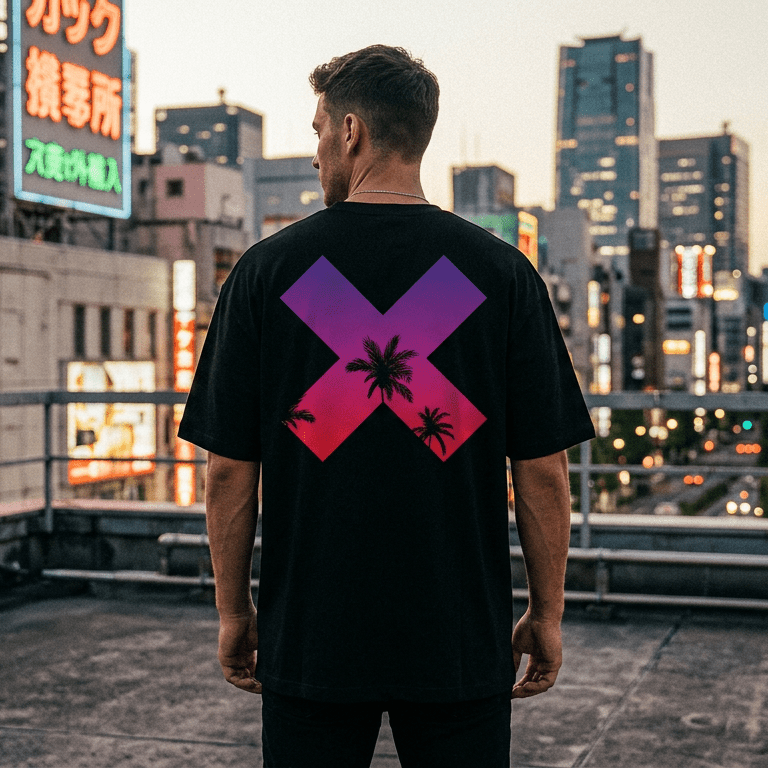
Our FUJI t-shirt takes Japan's most enduring symbol, ancient, immovable and quietly awe-inspiring, and sets it against the neon future. The FUJI hoodie rebuilds the silhouette in a full cyberpunk colour palette. The mountain has not changed; the world around it has.
Frequently asked questions
Why is Mount Fuji sacred?
It is considered the home of kami in Shinto, especially the goddess Konohanasakuya-hime, and has been a Buddhist and folk pilgrimage site for centuries.
When will Mount Fuji erupt again?
Nobody knows. It is classed as active and is closely monitored, but has been quiet since 1707.
Can you see Mount Fuji from Tokyo?
Yes, on clear days, most reliably on crisp winter mornings.
Keep your fixed point
See more designs rooted in Japanese landscape and myth in the full range, or read what a torii gate means.
New to NEOMACHI? Sign up to our emails and get 15% off your first order.