It is probably the most reproduced artwork in Asian history. A huge wave, claws of foam reaching over three small boats, Mount Fuji tiny in the distance. You have seen it on mugs, phone cases, tote bags and an emoji. Fewer people know what is actually happening in it, or how radical it was.
Who made the Great Wave?
Under the Wave off Kanagawa (神奈川沖浪裏, Kanagawa-oki nami ura) was designed by Katsushika Hokusai and published around 1831. Hokusai was already about seventy and had been working for decades. He once wrote that nothing he made before the age of seventy was worth noticing, and that he hoped to keep improving until he was well past a hundred.
The print is the opening image of his series Thirty-Six Views of Mount Fuji, which was so popular that the publisher added ten more views.
What is ukiyo-e?
The Great Wave is a ukiyo-e woodblock print: "pictures of the floating world". The artist drew the design; specialist carvers cut it into a set of wooden blocks, one per colour; printers then inked and pressed them by hand onto paper. Prints like this were not unique artworks. They were affordable popular images, made in large runs and sold for roughly the price of a bowl of noodles.
That is why dozens of original impressions survive today in museums including the British Museum, the Metropolitan Museum of Art and the Rijksmuseum.
What is happening in the picture?
Look closely and it is a scene of danger rather than beauty. Three oshiokuri-bune, fast boats that carried fresh fish to the markets of Edo, are caught beneath the wave. The rowers are bent low, gripping the boats, riding it out.
Despite a common assumption, it is not usually read as a tsunami. Most scholars describe it as a huge open-sea wave, perhaps a rogue wave, off the coast of Kanagawa.
And in the middle of all that movement sits Mount Fuji: small, still and permanent. The composition plays scale and perspective against each other. The wave is enormous now; the mountain has outlasted every wave. For more on why Fuji carries that weight, see what Mount Fuji means to Japan.
The blue that changed everything
Part of what made the print feel new was its colour. Hokusai used Prussian blue, a synthetic pigment invented in Europe in the early 18th century that had recently become affordable in Japan. Compared to traditional plant-based blues it was deep, vivid and did not fade as quickly. The series leaned heavily on it, and the public loved it.
How the Great Wave shaped Western art
When Japan opened up to international trade in the 1850s, ukiyo-e prints flooded into Europe. Artists were captivated by their flat colour, bold outlines and unusual compositions. The craze was called Japonisme.
- Vincent van Gogh collected Japanese prints and wrote admiringly about Hokusai's waves in letters to his brother.
- Claude Debussy chose the Great Wave for the cover of the first edition of his orchestral work La Mer.
- The Impressionists borrowed ukiyo-e's cropping, viewpoints and everyday subjects.
In other words, one mass-produced Japanese print helped rewire European art.
Why the Great Wave still works
It is a perfect graphic. Strong silhouette, a limited palette, a clear focal point and endless detail if you look closer. It reads instantly at any size, which is exactly why designers keep coming back to it, and why it translates so well to print and fabric.
The wave, reimagined
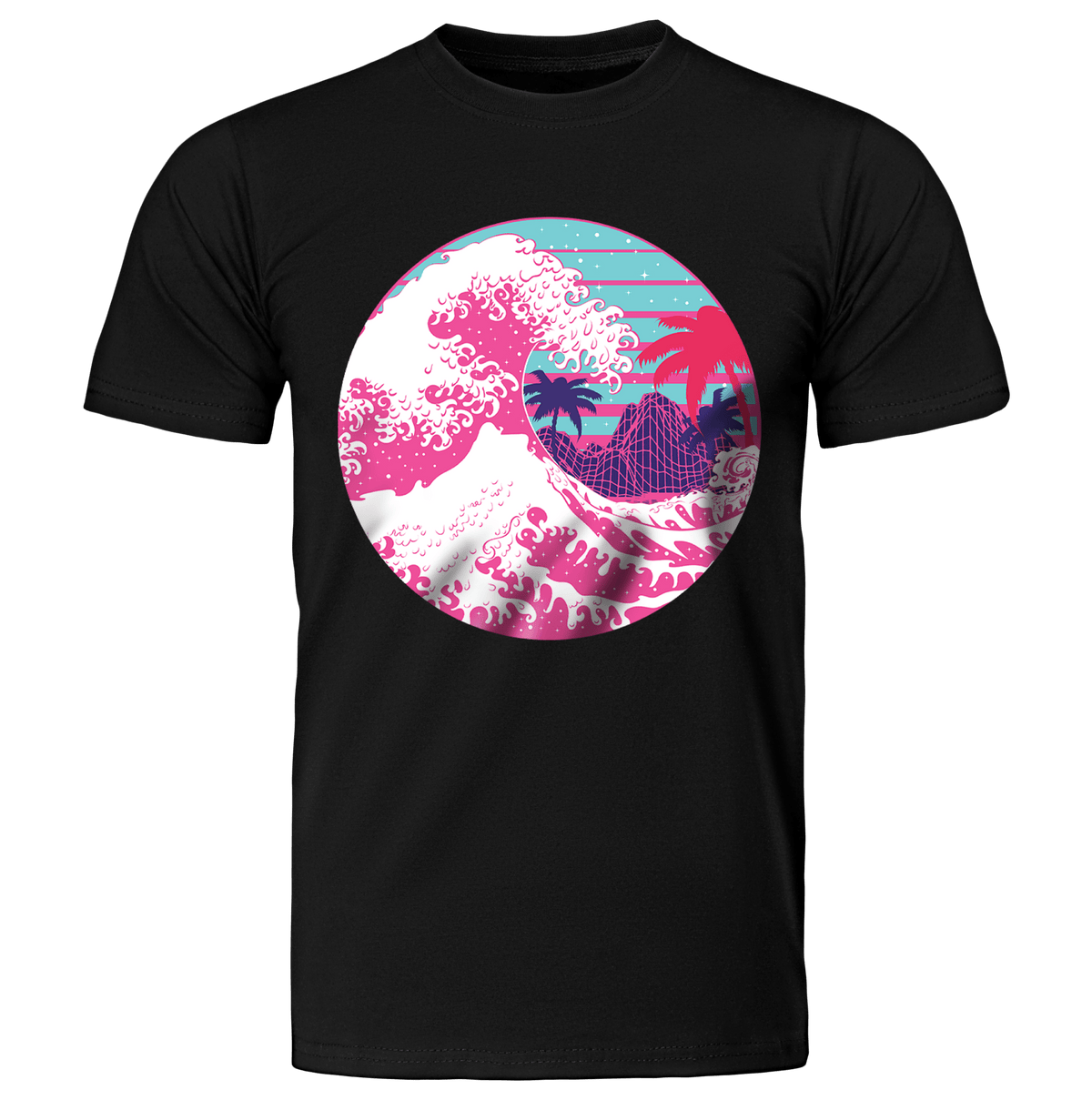
Ōnami means "big wave". Our ŌNAMI t-shirt takes the most iconic image in Japanese art and dresses it in a bold new jacket, while the ŌNAMI hoodie runs Hokusai's wave through a neon retrowave filter. If you like the crossover between classic Japanese imagery and synthwave colour, read cyberpunk vs vaporwave vs Y2K.
Frequently asked questions
Is the Great Wave a tsunami?
Usually not. It is generally interpreted as a very large open-sea or rogue wave rather than a tsunami.
How many original Great Wave prints exist?
Several thousand impressions were probably printed. Around a hundred are thought to survive in collections worldwide.
Where can you see the Great Wave?
Impressions are held by major museums including the British Museum, the Met, the Art Institute of Chicago and the Rijksmuseum, though they are displayed only occasionally to protect them from light.
What does the Great Wave symbolise?
Commonly the power of nature against human fragility, and the permanence of Fuji against a moment of chaos.
Ride it out
Explore more designs inspired by Japanese art, or see what landed most recently in new drops.
New to NEOMACHI? Sign up to our emails and get 15% off your first order.