Japanese peacock meaning, in one line: the peacock is kujaku (孔雀) in Japanese, and it stands for beauty, protection and good fortune, because Buddhist tradition says the peacock eats poisonous snakes and turns the poison into the colours of its feathers. That idea became a deity, Kujaku Myōō, the gentle "Peacock Wisdom King" who rides a peacock and was prayed to against poison, disease, disaster and drought.
It is a lovely bit of symbolism, and a very cyberpunk one if you think about it: take something toxic, run it through the system, output something beautiful. Here is where it comes from, how to read a peacock in Japanese art, and why we put one on a hoodie.
What does kujaku mean? The peacock in Japanese
孔雀 (kujaku) is the ordinary Japanese word for the peacock, the Indian blue peafowl. The bird is not native to Japan. It arrived from the Asian mainland and has long been kept in temple grounds, gardens and parks, especially around Kyoto, as the Japan Times nature column notes. So in Japan the peacock was always something rare and imported, a living treasure rather than a farmyard bird. That rarity is part of why it reads as luxury and good fortune in art.
The deeper meaning, though, comes from Buddhism, where the peacock is less a status symbol and more a protector.
Why the peacock eats poison
Peafowl really do eat snakes, along with insects and plants, and that made them look like natural guardians. Buddhist texts took the observation and turned it into a teaching. The JAANUS dictionary of Japanese art puts it beautifully: the peacock "eats poisonous plants and snakes joyfully, finding in them the nectar which produces its beauty".
Read that as a metaphor and you get the core of the peacock's meaning in Japanese Buddhism: the three "poisons" of greed, anger and ignorance can be eaten and transformed rather than simply avoided. The Tokyo National Research Institute for Cultural Properties even records a legend in which a peacock pretends to be afraid, lets a snake coil around it, then spreads its wings and flings the snake away. Fearless, a little theatrical, and very good-looking while doing it.
Kujaku Myōō: the Peacock Wisdom King
Kujaku Myōō (孔雀明王) is the Japanese form of Mahāmāyūrī, a Buddhist protector deity from India. The name means something like "great peacock" (or "great peahen", depending on the source). She is grouped with the myōō, the Wisdom Kings, but she breaks the mould.
The gentle one among the fierce
Most myōō are terrifying: flames, fangs, glaring eyes, the full guardian package. Kujaku Myōō is the exception. She has a calm, benevolent face, and because she is female some Japanese commentaries call her a bodhisattva, "Kujaku Butsumo Bosatsu", rather than a king. If you know the fierce faces of oni and akuma, she is their opposite: protection that looks serene instead of scary.
What she holds and rides
In the best-known Japanese paintings she sits on the back of a peacock, its tail fanned behind her like a halo. She usually has four arms, and the Kyoto National Museum explains what each hand holds:
- A lotus: compassion and benevolence.
- A citron fruit: said to cure the sickness of anyone who eats it.
- A pomegranate-like fruit: drives off evil spirits.
- A peacock feather: prevents disasters.
Some versions, like a famous Chinese Song-dynasty painting kept at Ninna-ji in Kyoto, show her with three faces and six arms.
What people prayed to her for
Her sutra contains a mantra against poison. In its story, a monk bitten by a black snake is healed by it. From there her job grew: protection from snakebite, illness and poisoning, then from disasters in general. In the Heian period the Kujaku Myōō ritual, part of esoteric Shingon Buddhism, was performed to avert calamity, to pray for rain in drought, against illness in the imperial family and for the safe childbirth of an empress. Kūkai, the monk who founded Shingon, helped bring her image and texts to Japan in the early 800s.
The most celebrated image is a 12th-century Heian silk painting in the Tokyo National Museum, a National Treasure, with fine cut-gold detail on the peacock's feathers. A sculpture by Kaikei from 1200 sits in the Peacock Hall (Kujakudō) at Kongōbu-ji on Mount Kōya.
What a peacock means in Japanese art and design
Put the bird and the deity together and the peacock carries a cluster of meanings you can use when you read, or wear, the motif:
- Protection: the guardian against snakes, poison and bad luck.
- Transformation: turning something harmful into something beautiful.
- Beauty and confidence: the fanned tail is the original statement piece.
- Good fortune and prosperity: a rare imported bird kept by temples and the wealthy.
- Rain and harvest: through the Kujaku Myōō rituals for ending drought.
The peacock also sits close to Japan's mythical birds. The hō-ō, Japan's phoenix, is often drawn with a long, patterned tail that owes a lot to the peacock, and the two share a role as auspicious birds. If you like this kind of symbolism, our guide to the Japanese phoenix meaning covers the hō-ō, fushichō and hinotori, and the kirin meaning post explains the phoenix's partner among the benevolent beasts. And since the peacock's great enemy is the serpent, the story of Susanoo and the eight-headed Orochi makes a good companion read.
Japanese peacock vs phoenix: how to tell them apart
They get mixed up on prints and tattoos all the time, so here is the quick check:
- Peacock (kujaku): a real bird, a crest of small feathers on the head, and a tail full of "eyes". Meaning: protection, beauty, transforming poison.
- Phoenix (hō-ō): a mythical bird with a mix of features, flowing ribbon-like tail plumes, often shown with paulownia trees or flames. Meaning: virtue, peace, renewal.
Both are good-luck birds, and both work well as large back prints, which is why you see them in irezumi-inspired art and on streetwear. For the bigger picture of what each animal and object stands for, see our guide to Japanese symbols and meanings.
Wearing the peacock: our KUZAKU design
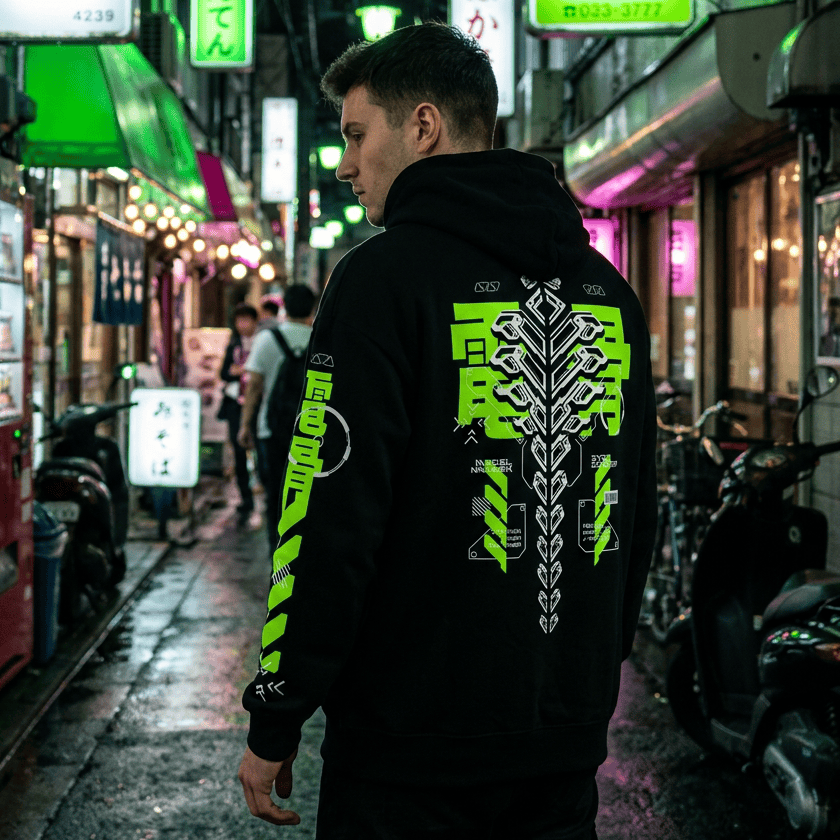
KUZAKU is our peacock design. It takes the bird's fanned tail, every eye on it, and pushes the colours into neon, so the old protector looks like it has been rebuilt in a Night City workshop. It is one of the most colourful pieces we make, which means it works best when everything around it stays quiet.

- KUZAKU hoodie: B&C Inspire Hooded, 80% organic cotton and 20% recycled polyester. True to size and slim, so size up for a baggier fit. Our hoodie fit guide has the measurements.
- KUZAKU t-shirt: Stanley/Stella Creator 2.0 organic cotton in a medium unisex fit. Take your usual size.

Want a matching bird? The FUSHICHO hoodie carries the phoenix, the peacock's mythical cousin. How to style it: one loud print, black or charcoal everywhere else, maybe one accent pulled from the print's colours. That is the same rule behind most of our cyberpunk hoodies and cyberpunk t-shirts, and the rest of our cyberpunk clothing is designed in Amsterdam and printed in Europe.

Frequently asked questions
What does the peacock mean in Japanese culture?
Protection, beauty and good fortune. Through Buddhism the peacock became a guardian that eats poisonous snakes and turns poison into beauty, which is the idea behind the deity Kujaku Myōō.
What is the Japanese word for peacock?
Kujaku, written 孔雀. Kujaku Myōō (孔雀明王) is the Buddhist "Peacock Wisdom King".
Is it kuzaku or kujaku?
The standard romanisation of 孔雀 is kujaku. KUZAKU is the name of our peacock design, so if you searched "kuzaku", you were probably looking for the KUZAKU hoodie or tee.
Who is Kujaku Myōō?
The Japanese form of Mahāmāyūrī, a Buddhist protector who rides a peacock. Unlike the fierce Wisdom Kings she has a gentle face, and she was prayed to against poison, snakebite, illness, disaster and drought.
What does a peacock tattoo mean in Japanese style?
Usually protection and transformation: the bird that eats snakes and wears the result as colour. Many people also choose it simply for beauty and confidence. If you are planning ink, read up on the motif and talk it through with your artist first.