


The Hachiko story in one line: Hachikō (ハチ公) was an Akita dog who met his owner, Professor Hidesaburō Ueno, at Shibuya Station in Tokyo, and who kept coming back to wait for him for almost ten years after Ueno died suddenly in 1925. His name means roughly "Mr Eight" or "dear Hachi", and today he is Japan's symbol of loyalty, with a bronze statue at Shibuya that is one of the most famous meeting points in the world.
If you have ever stood at the Shibuya Scramble, you have probably walked past him. Neon screens above, thousands of people crossing in every direction, and in the middle of it all a small bronze dog, sitting very still, still waiting. It is hard to think of a better image of the city we love drawing: hyper-modern on top, something old and stubborn underneath. Here is the real story, what the name means and why Hachikō still matters a century later.
Who was Hachiko? The true story
Hachikō was born in November 1923 on a farm near Ōdate, in Akita Prefecture in northern Japan. In January 1924 the puppy was sent to Tokyo to live with Hidesaburō Ueno, a professor of agriculture at Tokyo Imperial University (now the University of Tokyo) and one of the pioneers of agricultural engineering in Japan.
The routine that made him famous is simple. Ueno commuted by train, and Hachi would walk with him to Shibuya Station in the morning and come back to meet him there in the evening. They had barely a year and a half together. On 21 May 1925, Ueno died of a brain haemorrhage while at work, and never came home.
Hachikō did not stop going to the station. Over the next nine years and ten months he turned up at Shibuya, day after day, at around the time Ueno's train used to arrive. At first the commuters and station staff were far from kind: he was shooed away, kicked and splashed with water. A few vendors and station workers looked after him, but mostly he was just a scruffy dog that would not leave.
That changed in 1932, when the newspaper Asahi Shimbun ran a story about him. Overnight, the stray became a national figure. People travelled to Shibuya to see him, brought him food and started calling him by the affectionate name that stuck: Hachikō.
He died on 8 March 1935, at the age of eleven, near Shibuya Station. A re-examination around 2010–11 of his preserved organs found he had terminal cancer as well as a heartworm infection; the yakitori skewers found in his stomach, which fuelled rumours for decades, were not the cause.
One honest footnote: some historians, including researchers at the University of Tokyo, think the daily station routine may have been simplified over the years, and that Ueno often walked to work. The core of the story is not in dispute, though. Hachikō kept coming back to Shibuya for nearly a decade, and the whole country noticed.

What does Hachiko mean? The name explained
Hachi (八) means "eight" in Japanese. The most likely explanation is simply that he was counted as number eight, and eight is also a lucky number in Japan because the character 八 widens towards the bottom, like a future that keeps opening up.
Kō (公) is an old honorific, once used for lords and dukes. Added to a pet's name, it becomes affectionate and a little tongue-in-cheek, something like "Lord Hachi" or "good old Hachi". The suffix caught on after the 1932 newspaper story. So "Hachikō" is not his registered name; it is the name the public gave him because they loved him.
In Japanese, Chūken Hachikō (忠犬ハチ公) means "faithful dog Hachikō", and that is how most Japanese children learn about him at school.
The Hachiko statue at Shibuya
The first bronze statue of Hachikō, by the sculptor Teru Andō, was unveiled at Shibuya Station in April 1934, while Hachikō was still alive. He is said to have been at the ceremony. During the Second World War the statue was melted down for metal, and in 1948 Andō's son Takeshi made the replacement that stands there today.
The exit it sits next to is called the Hachikō Exit, and "meet me at Hachikō" is one of the most common sentences in Tokyo. Every year on 8 March a remembrance ceremony is held at the statue.
There are more Hachikōs to find if you travel:
- University of Tokyo, Yayoi campus: a 2015 statue shows Hachikō finally reunited with Professor Ueno, jumping up to greet him.
- Ōdate, Akita: his home town has its own Hachikō statues.
- National Museum of Nature and Science, Ueno Park: his preserved body is on display.
- Aoyama Cemetery: a memorial stands beside Professor Ueno's grave.
Why Hachiko became Japan's symbol of loyalty
Loyalty (chūgi) runs deep in Japanese culture. It is one of the core virtues of the samurai code, which we unpack in the seven virtues of bushido, and it is the beating heart of the story of the 47 rōnin. Hachikō gave that old ideal a gentle, everyday face that anyone could understand.
Not all of it was gentle, to be fair. In the 1930s the government also used Hachikō as a model of devotion to push loyalty to the state. But the story outlived the propaganda, because what people respond to is much simpler: a creature that refuses to give up on someone it loves.
He also helped save his breed. Akitas were rare by the early twentieth century, and the attention around Hachikō revived interest in the Akita in Japan and, much later, helped make it a well-known breed around the world.
Hachiko films: from Hachikō Monogatari to Hachi: A Dog's Tale
The story has been filmed three times. Hachikō Monogatari (1987) was a major hit in Japan. Hachi: A Dog's Tale (2009), starring Richard Gere, moved it to a train station in New England and made Hachikō famous in the West. A Chinese adaptation followed in 2023, the year of his hundredth birthday. Bring tissues for all three.

Hachiko in 2077: our HACHIKO design
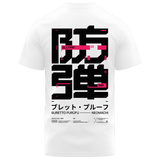
Our HACHIKO design asks a simple question: what if the wait never ended? We put Japan's most loyal dog in Shibuya, 2077, fitted with a cybernetic jacket. The city around him has changed beyond recognition, the screens are bigger and the colours have shifted, but he is still sitting in the same spot. Loyalty, upgraded.
It is a quiet design for people who like their cyberpunk clothing with a bit of heart, and it is a lovely gift for anyone who has a dog, loves Akitas or cried at Hachi. It comes as a:
- HACHIKO hoodie: true to size and slim; size up for a relaxed fit (more in how a hoodie should fit).
- HACHIKO t-shirt: medium unisex fit in organic cotton.
- HACHIKO zip hoodie, HACHIKO sweater and women's tee.
For more Japanese folklore on fabric, browse our cyberpunk hoodies and cyberpunk t-shirts. If it is lucky animals you are after, Hachikō has good company in the maneki-neko lucky cat and Japan's sacred wolf, the ōkami. And if Shibuya itself is the draw, our Japanese streetwear guide covers the district's style, while why cyberpunk is so Japanese explains why Tokyo became the blueprint for every neon future.

Frequently asked questions
What is the story of Hachiko?
Hachikō was an Akita who walked his owner, Professor Hidesaburō Ueno, to and from Shibuya Station in Tokyo. After Ueno died suddenly at work in 1925, Hachikō kept returning to the station to wait for him for almost ten years, until his own death in 1935.
Is Hachiko a true story?
Yes. Hachikō was a real dog (1923–1935), his owner was a real professor at Tokyo Imperial University, and his preserved body is on display in Tokyo today. Some details, like an exact daily routine, have been polished over the years, but the heart of the story is true.
What does the name Hachiko mean?
Hachi (八) means "eight", and kō (公) is an affectionate honorific, a bit like "Lord" or "good old". Together it means something like "dear old Hachi".
How long did Hachiko wait?
Nine years and ten months, from Professor Ueno's death in May 1925 until Hachikō died in March 1935.
Where is the Hachiko statue?
Outside the Hachikō Exit of Shibuya Station in Tokyo, right by the Shibuya Scramble crossing. Other statues stand at the University of Tokyo and in his home town of Ōdate, Akita.
NEOMACHI's HACHIKO design is our own artistic tribute and is not affiliated with the makers of any Hachikō film.
New to NEOMACHI? Sign up to our emails for a monthly chance to win €250 to spend at NEOMACHI.