Japanese folklore is crowded with monsters, and English tends to flatten them all into one word: demon. But an oni, an akuma and a yōkai are very different things. Knowing which is which makes a lot of Japanese art, anime and design suddenly make more sense.
Yōkai: the big umbrella
Yōkai (妖怪) is the broadest term. It covers almost every supernatural creature in Japanese folklore: spirits, shapeshifters, haunted objects and outright monsters. Some are dangerous, some mischievous, and some simply strange.
A few well-known examples:
- Kappa: river creatures with a water-filled dish on their heads.
- Tengu: long-nosed or bird-like mountain spirits, masters of martial arts.
- Kitsune: shapeshifting foxes; see our guide to kitsune.
- Tsukumogami: household objects that come to life after a hundred years.
Oni are technically a type of yōkai, just the most fearsome and famous one.
Oni: Japan's ogres
When people picture a Japanese demon, they picture an oni (鬼): a huge, muscular figure with red or blue skin, horns, fangs, wild hair and an iron club called a kanabō, wearing a loincloth made of tiger skin.
Oni are often translated as "ogre" rather than "demon". In Buddhist-influenced stories they torment the dead in hell; in folk tales they raid villages, kidnap people and are eventually defeated by heroes. The most famous is Momotarō, the Peach Boy, who travels to Onigashima, the island of demons.
Why do oni have horns and tiger skins?
This is one of the neatest details in Japanese folklore. In traditional geomancy, the northeast was the direction from which evil entered: the kimon, or "demon gate". In the old zodiac-based compass, northeast was called ushitora: ox-tiger. So the creatures coming from that direction were given the horns of an ox and the skin of a tiger.
Many old Japanese buildings and cities were planned with the northeast in mind, placing temples or shrines there for protection.
Setsubun: throwing beans at demons
Every year around 3 February, Japan celebrates Setsubun, the eve of spring. Families throw roasted soybeans out of the door, or at a family member wearing an oni mask, while shouting "Oni wa soto! Fuku wa uchi!": "Demons out! Luck in!" It is part purification ritual, part chaos.
The oni on a hoodie
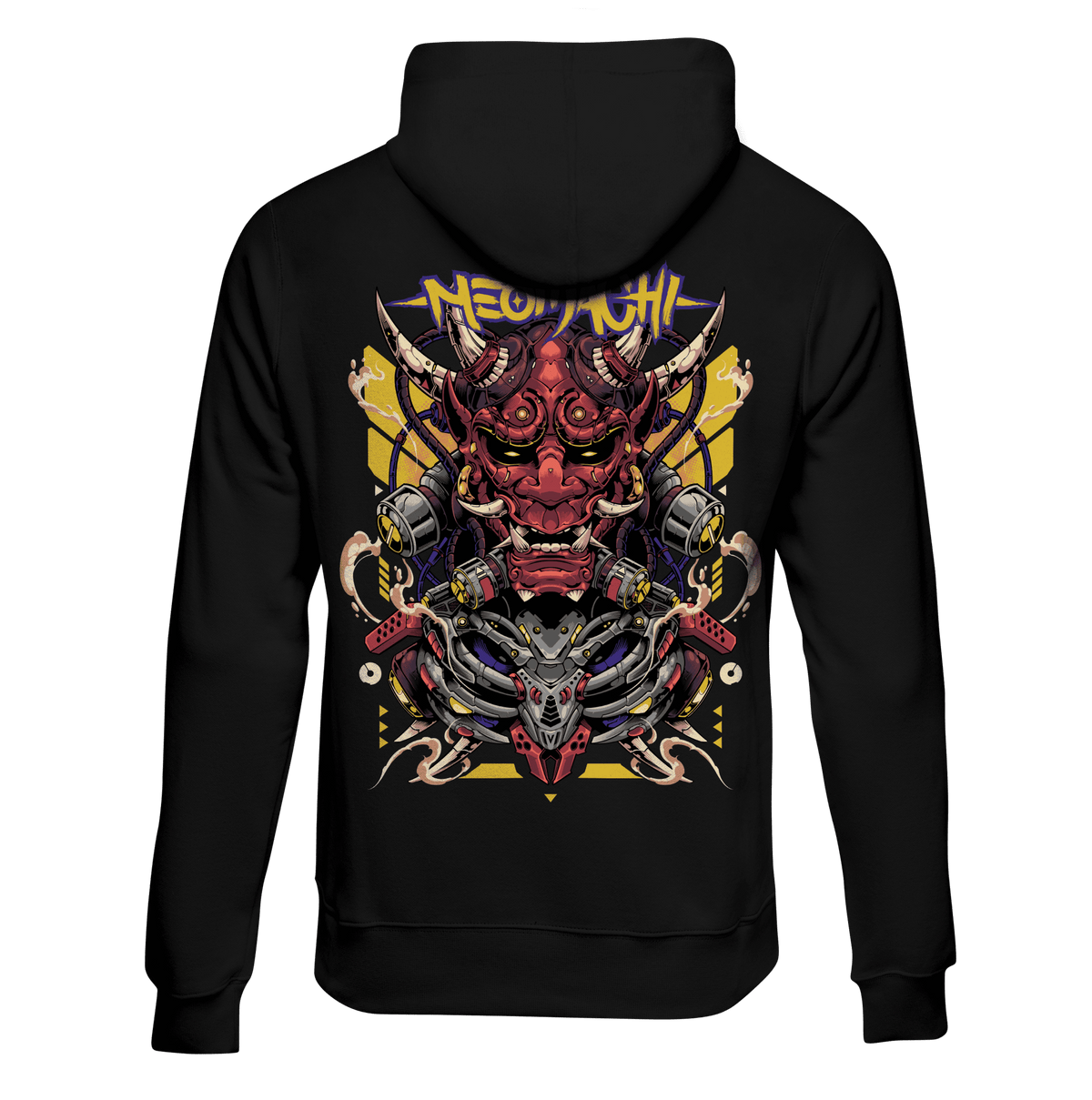
Our ONI design renders that mask in graphic form, with futuristic framing around something considerably older. It comes as a hoodie, a zip hoodie, a t-shirt and a premium bomber. What the other recurring figures on our hoodies mean is in how to choose a cyberpunk hoodie.
Akuma: the devil
Akuma (悪魔) means something closer to "devil" or "evil spirit". The word comes from Buddhism, where it was used for Mara, the tempter who tried to stop the Buddha reaching enlightenment. In modern Japanese, akuma is also the everyday word for the devil in the Western, Christian sense.
So while an oni is a specific creature with a specific look, an akuma is more abstract: pure malevolence. It is less about horns and clubs and more about corruption and temptation. That is why the word turns up so often in games and anime for final bosses and dark forces.
Hannya: the jealous demon
One more worth knowing. The hannya mask, used in Noh theatre, shows a woman transformed into a demon by jealousy and rage: horns, a wide grin, anguished eyes. It is hugely popular in tattoos, where it can represent the complexity of emotions or protection against bad luck.
The protectors: why the tiger matters
Japanese mythology balances its demons with guardians. The tiger is one of the strongest: a symbol of courage and protection against evil spirits. Our TORA t-shirt draws on exactly that (tora means tiger) as a guardian figure for the neon age.
Demons in the neon city
Oni masks and demonic imagery are a fixture of cyberpunk, and it is no accident. Cyberpunk is full of blurred lines between human and something else, which is exactly the territory yōkai stories have always explored. More on that in why cyberpunk is so Japanese.
Our AKUMA t-shirt pulls from the darkest corners of Japanese mythology and drags them into 2049, where digital demons walk among us. It also comes as an AKUMA hoodie.
Frequently asked questions
What is the difference between an oni and an akuma?
An oni is a specific folkloric creature: horned, club-wielding, ogre-like. Akuma is a broader word for a devil or evil spirit, rooted in Buddhism and used today for the Western devil.
Are all yōkai evil?
No. Many are neutral, playful or even helpful. Yōkai is a catch-all for the supernatural.
What does an oni mask symbolise?
Depending on context: strength, protection by fear (scaring off worse evils), or punishment of wrongdoing.
Are oni always red?
No. Red and blue are most common, but oni appear in green, yellow and black too.
Face your demons
See more folklore-driven designs in our hoodies and t-shirts.
New to NEOMACHI? Sign up to our emails and get 15% off your first order.