You have seen it on shop counters from Tokyo to Amsterdam: a round-faced cat with one paw raised, sometimes moving back and forth on a little motor. Most people call it the lucky cat or the waving cat. It is actually neither quite as simple nor quite as Chinese as people think.
What is a maneki-neko?
Maneki-neko (招き猫) literally means "beckoning cat". It is a Japanese talisman believed to bring good fortune, and it is especially popular with businesses: shops, restaurants and bars put one near the entrance to draw in customers and money.
Although it is often associated with Chinese restaurants in the West, the maneki-neko originated in Japan, most likely in the Edo period (1603 to 1868).
It's not waving, it's beckoning
To Western eyes the cat looks like it is saying hello. In Japan, the gesture for "come here" is made with the palm facing forward and the fingers moving down. The cat is calling luck, customers and money towards you, not waving goodbye.
Left paw or right paw?
This is the question everyone asks, and conventions vary, but the most common reading is:
- Raised left paw: invites customers and people. Popular with bars and restaurants.
- Raised right paw: invites money and good fortune.
- Both paws raised: both at once, or protection. Some people see this as greedy; others just want everything.
The height of the paw matters too. The higher it is raised, the further the luck is said to reach.
What do the colours mean?
- White: happiness, purity and general good luck. The most traditional.
- Gold: wealth and prosperity.
- Black: protection; wards off evil spirits and bad luck.
- Red: good health and protection from illness.
- Calico (white, black and orange): considered especially lucky, because calico cats are rare among males and were prized by sailors.
- Pink: love and relationships.
What is the cat holding?
Many maneki-neko hold a gold coin called a koban, an Edo-period currency. It is often inscribed with sen ryō (千両), a thousand ryō, a vast fortune at the time. The bib and bell around its neck echo how cats of wealthy households were dressed.
The legend of Gōtoku-ji
Several places claim to be the birthplace of the lucky cat. The most famous is Gōtoku-ji, a temple in Setagaya, Tokyo.
As the story goes, a feudal lord, Ii Naotaka, was caught in a storm and sheltering under a tree when he noticed the temple priest's cat beckoning to him. He walked over, just before lightning struck the tree where he had been standing. In gratitude, he became the temple's patron, and the struggling temple prospered.
Today Gōtoku-ji is filled with thousands of small white maneki-neko left by visitors, and it is one of Tokyo's most photographed sights.
Rival legends point to the Imado Shrine in Asakusa, where a poor old woman was told in a dream to make a clay figure of her cat, and sold so many she became wealthy.
Maneki-neko Day
Japan celebrates Maneki-neko Day on 29 September. The date is a pun: 9-2-9 can be read as ku-ru-fuku, "good fortune comes". Festivals are held in several cities, including a large one in Seto, a historic pottery town.
The lucky cat, reimagined
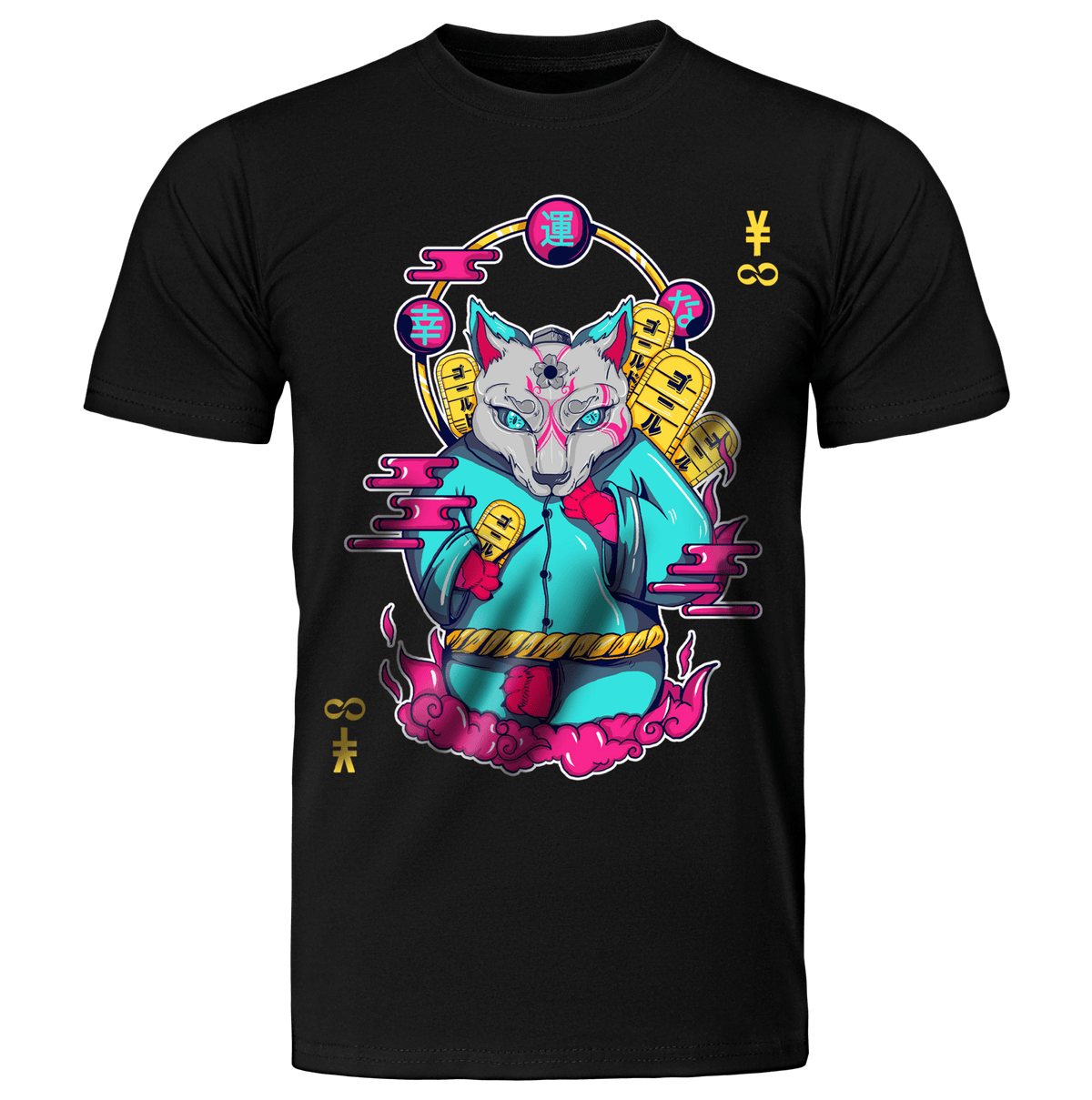
Our MANEKI-NEKO t-shirt takes the centuries-old beckoning cat and gives it a new jacket: the same raised paw, calling luck towards whoever wears it. It also comes as a hoodie.
Curious about the other lucky symbols? Read Japanese symbols and their meanings.
Frequently asked questions
Is the maneki-neko Chinese or Japanese?
Japanese. It became widely associated with Chinese businesses abroad, but its origins are in Edo-period Japan.
Where should you put a maneki-neko?
Traditionally near the entrance of a business or home, facing the door, so it can beckon luck inside.
Which paw brings money?
By the most common convention, the right paw invites money and the left invites customers.
What does a black lucky cat mean?
Protection from evil and bad luck. Black maneki-neko are sometimes carried as charms against harm.
Invite some luck in
Browse more graphic t-shirts drawn from Japanese folklore, or read about the nine-tailed fox.
New to NEOMACHI? Sign up to our emails and get 15% off your first order.