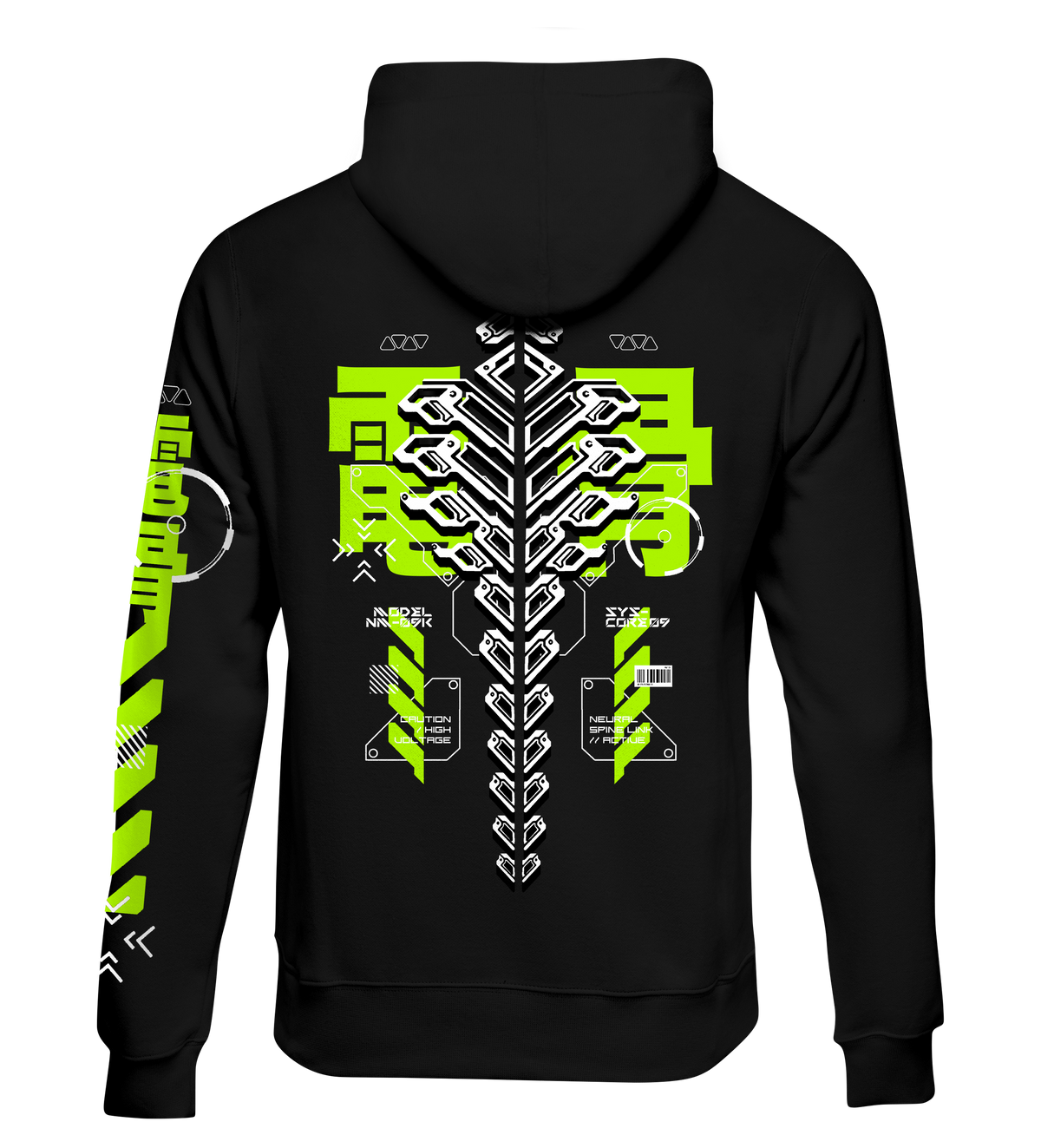
Japanese cyberpunk fashion is clothing that treats the future as something you might have to survive: mostly black, built around strange or functional shapes, and often carrying Japanese type that means something. Search for it and you will mostly find neon and random kanji. The real story is better, because several of the ideas we now call cyberpunk were on Tokyo streets and Paris runways before most of the West had a word for them.
A disclaimer before we start: NEOMACHI is a Dutch label, designed in Amsterdam, not a Japanese one. We owe this history a lot, so we would rather tell it properly than borrow it quietly. Here are the designers and scenes that built the look, and how to wear it today without looking like you are on your way to a convention.
Why Japanese cyberpunk looks different
Western cyberpunk fashion usually starts from a film: a long coat, mirrored glasses, a costume somebody once wore. Japanese designers came at the same mood from the body and the garment itself. What happens if a jacket has no fixed shape? What if clothing becomes shelter? What if a torso is something you can cast in plastic? That is the same question cyberpunk asks about bodies and machines, only asked with scissors.
If you want the wider version of the story, covering neon, signage and why the genre's default city is Tokyo, read why cyberpunk is so Japanese. This article stays on the clothes.
Five moments that built Japanese cyberpunk fashion
1. The crow tribe, 1981
When Rei Kawakubo of Comme des Garçons and Yohji Yamamoto showed in Paris in 1981, the European press did not know what to do with the black, torn, asymmetrical clothes. Back in Tokyo, the young people who dressed in head-to-toe black were nicknamed karasu-zoku, the crow tribe. Every all-black cyberpunk outfit you have ever seen owes them something. Black stopped being a safe choice and became a position.
2. Issey Miyake's plastic body, 1980
Around the same time, Issey Miyake moulded a bustier out of plastic, shaped like a torso, closer to a piece of armour than a blouse. It is one of the earliest moments where fashion openly asks what a manufactured body looks like. Decades later, the same idea came back as chrome and cyberware in games and anime.
3. Bikers, Akira and the embroidered jacket, 1988
The gangs in Akira were drawn from real bōsōzoku biker culture and its kanji-covered uniforms. We trace that jacket in detail in a history of cyberpunk fashion in 7 garments, and show how to wear it in Akira outfit ideas. A year later, Shinya Tsukamoto's film Tetsuo: The Iron Man (1989) pushed the flesh-and-metal idea somewhere much darker, and it is still the reference for anyone who wants their cyberpunk industrial rather than pretty.
4. Final Home, the coat you could live in, 1994
This is our favourite, and it should be better known. Kosuke Tsumura, who worked with Issey Miyake, launched Final Home in 1994 around a sheer nylon parka conceived for someone who has lost their home to war, disaster or unemployment. The version held by MoMA has 44 pockets for food, medicine and tools, and you can stuff them with newspaper for insulation. Before the word techwear existed, here was a garment that took the end of the world seriously, as a design brief.
5. Cav Empt and the computer graphic, 2011
Cav Empt, founded in 2011 by Sk8thing, Toby Feltwell and Hishiyama Yutaka, made heavy, strange, machine-age graphics on ordinary hoodies and sweatshirts. It proved that you did not need an exotic shape to feel like the future. A familiar garment and an unsettling image were enough, and most modern graphic cyberpunk streetwear, ours included, lives in that space. For the wider scene, see our Japanese streetwear guide.

The cyber kimono: tradition plugged in
The most literal version of Japanese cyberpunk fashion came from an artist called Tanago, who calls herself Cyber Mum. In 2020 My Modern Met covered her electro kimono, with a circuit-board print, a visor and a backpack of neon tubing spelling Denno, the word for cyberbrains in Ghost in the Shell. It works for the same reason the genre works: the old thing and the new thing are in the same frame, and neither one apologises. If you want more of that collision, our piece on the cyberpunk samurai follows it through katanas and neon.
How to wear Japanese cyberpunk fashion today
You do not need archive pieces or a kimono. Four rules get you most of the way.
Start with black, on purpose
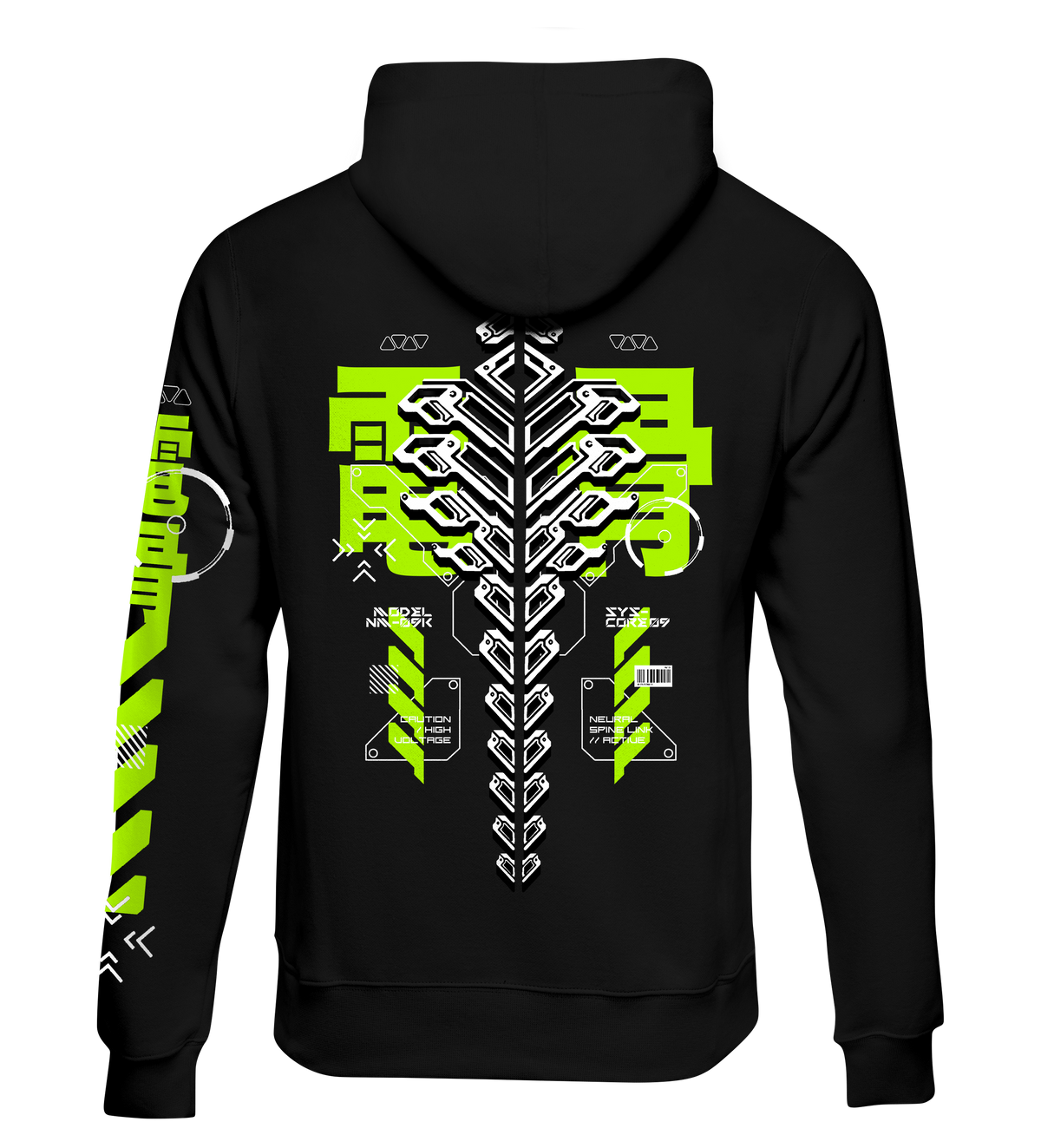
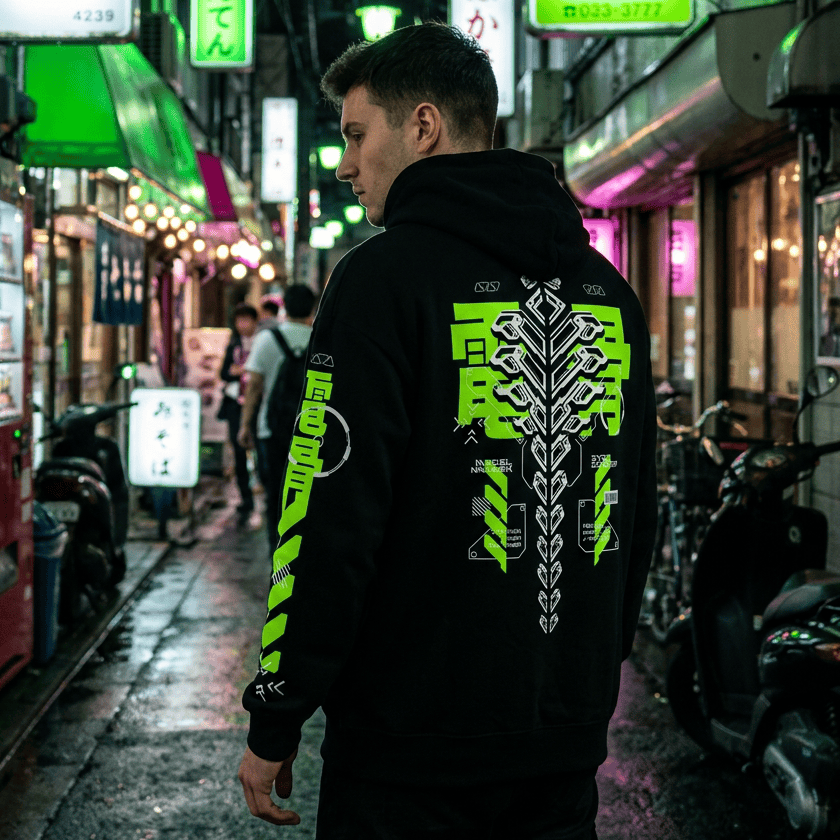
The crow tribe rule. Build the outfit from black layers in slightly different textures and let the shapes do the work. Add one graphic, not three. The KISEKI hoodie (奇跡, miracle, with a neural spine in neon green down the back) is the kind of piece that carries a whole outfit on its own.
Pick a garment with a job
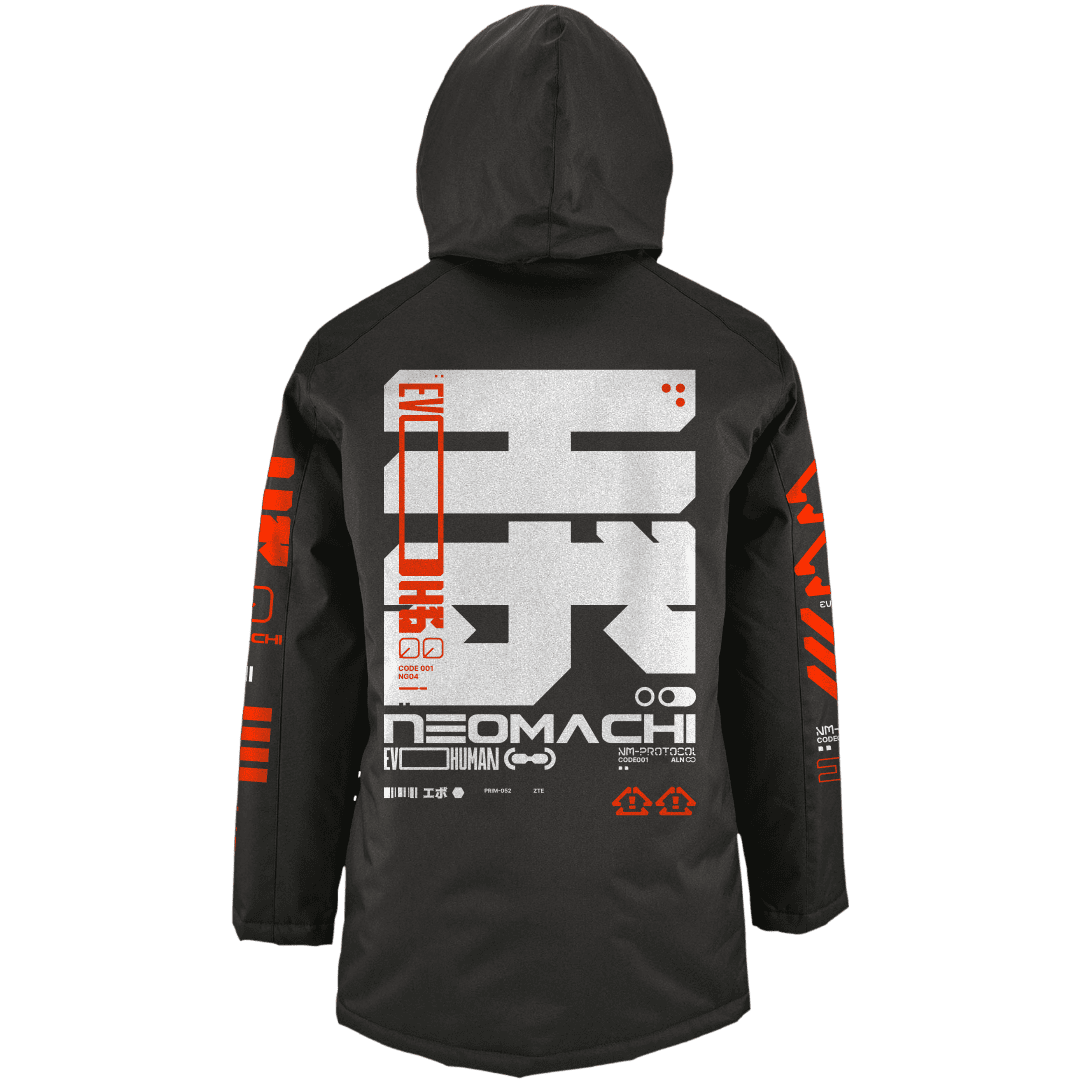
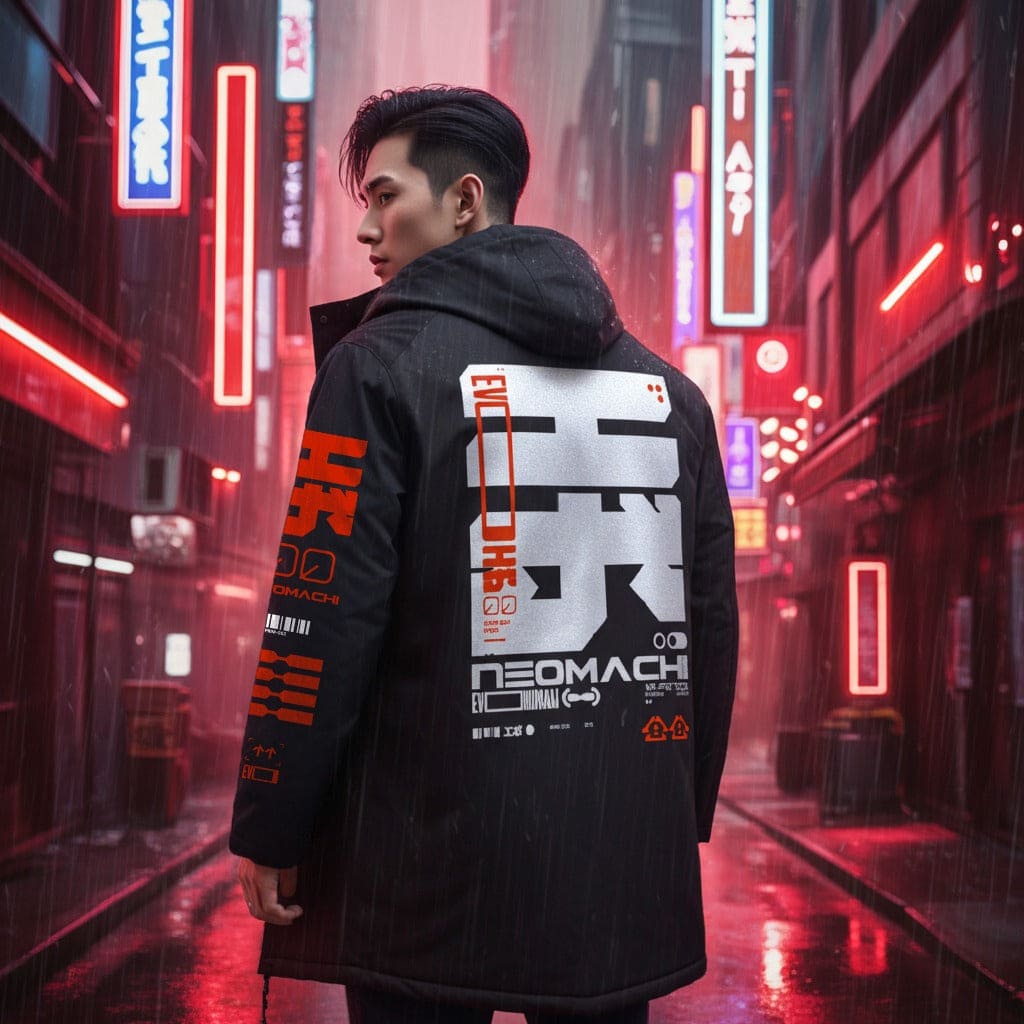
The Final Home lesson. Pockets, a real shell and a shape that handles weather read as more futuristic than any amount of neon. The BLLTPRF parka or EVO windbreaker with NM cargo pants covers this, and our techwear vs cyberpunk guide explains where one ends and the other begins.
Know what your kanji says
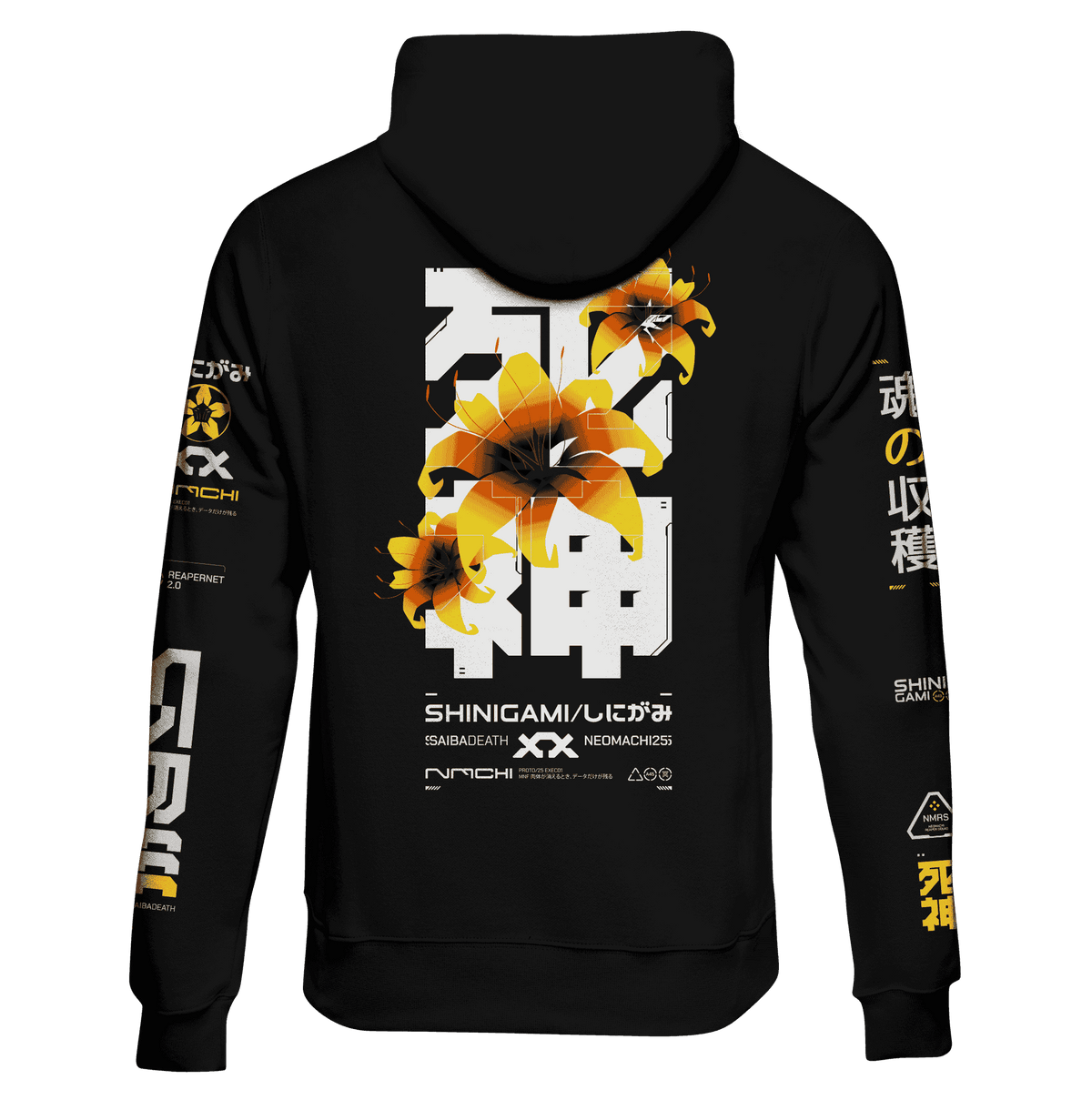
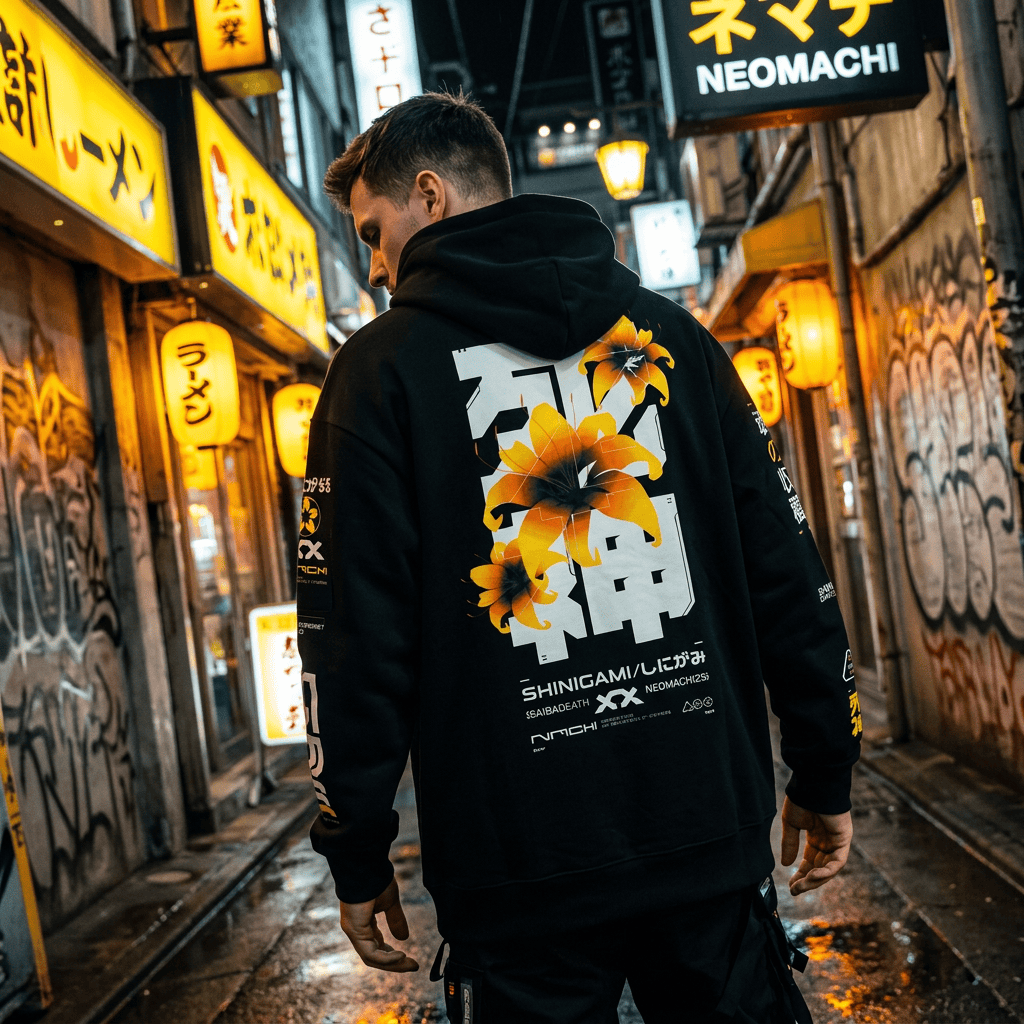
This is the rule that separates respect from decoration. Japanese readers can read your jacket, so choose text you would be happy to say out loud. The EIKOU hoodie carries 栄光, glory. The SHINIGAMI hoodie carries 死神, death god, with spider lilies from Japanese folklore. Our guide to Japanese symbols and meanings and cyberpunk graphics explained will help you check before you buy, and if you are drawn to tattoo imagery, read the irezumi guide first.
Let tradition and machine share one piece
The cyber kimono idea, in a form you can wear on a Tuesday. The KABUKI tee rebuilds Japanese theatre in a futuristic frame, and the ONI premium bomber gives the old demon mask a technical setting. Wear either with plain black and stop there. Our full range of cyberpunk t-shirts and cyberpunk hoodies runs on the same idea.


A quick word on fit
Japanese street style tends to play with volume, so think about proportion before you order. Our hoodies are true to size and slim, so size up if you want the looser, layered shape. Our tees have a medium unisex fit, and sizing up gives you a more relaxed drape. How should a hoodie fit? goes through it with measurements.
Frequently asked questions
What is Japanese cyberpunk fashion?
Clothing influenced by Japan's part in the cyberpunk story: mostly black outfits, experimental or functional shapes, and Japanese type used with meaning. Its roots run through Comme des Garçons and Yohji Yamamoto, Issey Miyake, bōsōzoku biker uniforms, Final Home and Cav Empt.
Which Japanese brands are closest to cyberpunk?
Cav Empt is the name most people start with for graphics, and the archive of Final Home for the survival idea. For the broader scene, our Japanese streetwear guide covers the labels that shaped it. ACRONYM is often mentioned too, but it is a Berlin label.
Is it okay to wear kanji if you do not read Japanese?
Yes, as long as you know what it says and the design treats the reference with some care. Check the meaning first, and avoid text picked only because it looks good.
Is NEOMACHI a Japanese brand?
No. NEOMACHI is an independent brand from Amsterdam, with designs printed in Europe. Our designs are drawn by artists who love Japanese art and folklore, and we explain the meaning behind them on every product page.
Wear the district
Original cyberpunk clothing built on Japanese art and folklore, drawn by real artists rather than generated by a filter.
Shop cyberpunk hoodies → | Shop cyberpunk t-shirts → | Shop cyberpunk bombers →