Kirin meaning, in one line: the kirin (麒麟) is the Japanese name for the qilin, a gentle, hooved and often single-horned creature from East Asian myth whose appearance signals a wise ruler, the birth of a sage and an age of peace. In everyday modern Japanese, kirin also simply means "giraffe", and there is a great story behind that.
Here is what the word means, what a kirin looks like, how the Japanese kirin differs from the Chinese qilin, and why a holy beast that refuses to step on grass ended up glowing on a cyberpunk hoodie.

What does kirin mean?
The word is written with two kanji, both of which contain the radical for deer (鹿):
- 麒 (ki): traditionally the male of the creature.
- 麟 (rin): traditionally the female.
That split goes back to the Shuowen Jiezi, a Chinese character dictionary from around 100 CE. Together, 麒麟 names the creature as a whole. Japanese reads it kirin, Chinese qílín, Korean girin and Vietnamese kỳ lân. Same animal, four accents.
As a symbol, the kirin means benevolence, good government, prosperity and the arrival of someone exceptional. It is one of the four benevolent animals of classical Chinese texts, alongside the dragon, the phoenix and the tortoise.
What does a kirin look like?
There is no single official kirin, which is part of the fun. Most depictions mix a few recurring features:
- A dragon-like head with a beard, thick eyelashes and a mane that flows upwards.
- A body that is part deer, horse or ox, often fully or partly covered in scales.
- Cloven hooves.
- Usually one horn, sometimes two.
- Flames trailing from the body in many paintings and statues.
Despite looking like a fire-breathing chimera, the kirin is the gentlest creature in the bestiary. In folklore it walks without bending a blade of grass, avoids harming living things and only punishes the wicked. Think of it less as a monster and more as a living omen of good times.
Kirin vs qilin: what is the difference?
Strictly speaking, none: kirin is how Japanese reads the Chinese 麒麟. The differences are in how each culture draws and ranks it.
| Chinese qilin | Japanese kirin | |
|---|---|---|
| Look | Often stockier, lion- or dragon-like, scaled | More slender and deer-like, sometimes with a backward-curving horn |
| Rank | Revered, but usually listed after the dragon and phoenix | Often treated as the most powerful of holy beasts, a kami in its own right |
| Meaning | Sign of a sage or a just ruler | Same, plus purity and good fortune |
| Modern word | Qilin stays mythical | Kirin also means giraffe |
Korea's girin sits between the two, usually drawn with a deer-like body, an ox tail and horse-like hooves, and it too doubles as the modern word for giraffe.
The legend: sages, emperors and Confucius
The qilin is old. It appears in the Classic of Poetry, a collection of songs written between roughly the 11th and 7th centuries BCE. Later legends place qilin in the garden of the Yellow Emperor and in the capital of the sage-king Yao, both shorthand for "this ruler was good".
The most famous story belongs to Confucius. A qilin was said to have appeared before his birth to announce that a great teacher was coming. Decades later, in 481 BCE, the Spring and Autumn Annals record a lin being captured, and Confucius, who identified it, read it as a sign his own time was ending. The kirin bookends a life: it turns up when something important begins and when it ends.
Why kirin means giraffe in Japanese
In 1414, a giraffe brought to China during the voyages of admiral Zheng He's treasure fleet was presented at the court in Nanjing. The long neck, gentle temperament and patterned coat convinced the court it was looking at a living qilin, and the Yongle Emperor reportedly accepted it as one.
The name stuck. Today a Japanese child at the zoo points at a giraffe and says kirin, and a Korean child says girin. Next time you see a Japanese beer label or a kids' book with a kirin on it, you know the six-century detour behind the word.
Is the kirin a unicorn?
It gets called "the Japanese unicorn" a lot, and it is not a terrible shorthand: both are rare, single-horned, pure and almost impossible to catch. But the European unicorn is a horse with a horn, while the kirin is a chimera with scales, hooves, a dragon's face and often flames. The kirin is also about society, not just purity: it shows up because a good ruler is in charge.
The kirin in games and anime
If the name sounds familiar, it is probably because of games. Monster Hunter turns Kirin into a white, lightning-throwing Elder Dragon with a single horn. Final Fantasy uses Kirin as a summon and holy beast. In the fantasy novel and anime series The Twelve Kingdoms, kirin choose the rulers of each kingdom, a direct nod to the old idea that the creature recognises a worthy leader. Same myth, new interfaces.
Why a kirin belongs in cyberpunk
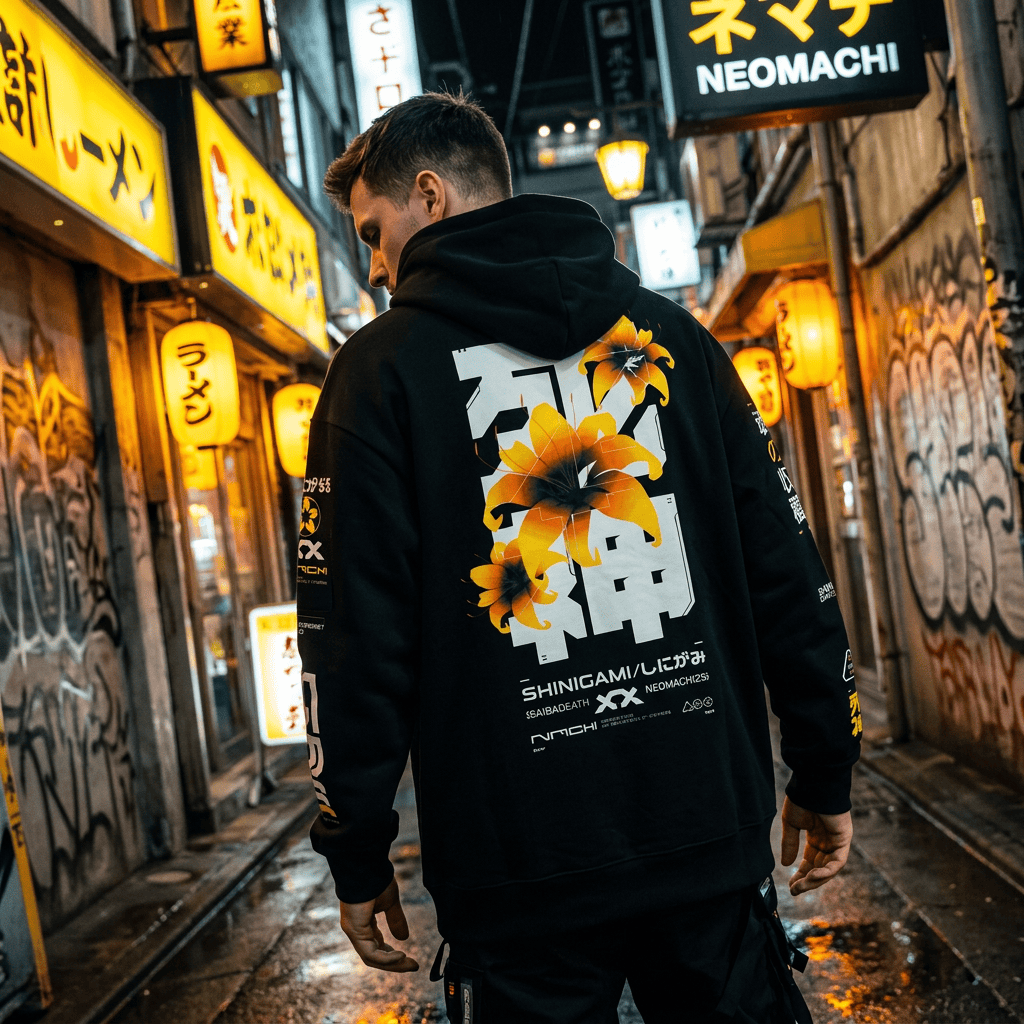
Cyberpunk is full of power that does not deserve to be in charge: megacorps, rigged systems, cities that run on someone else's terms. The kirin is the opposite idea, a creature that only appears when power is used well. Putting it in neon and circuitry is a small act of hope inside a dark aesthetic, and it is the same push and pull that explains why cyberpunk is so Japanese in the first place: ancient symbols, futuristic surfaces.
Wearing the kirin: our KIRIN and QILIN designs
We have two takes on the creature, because one was not enough.
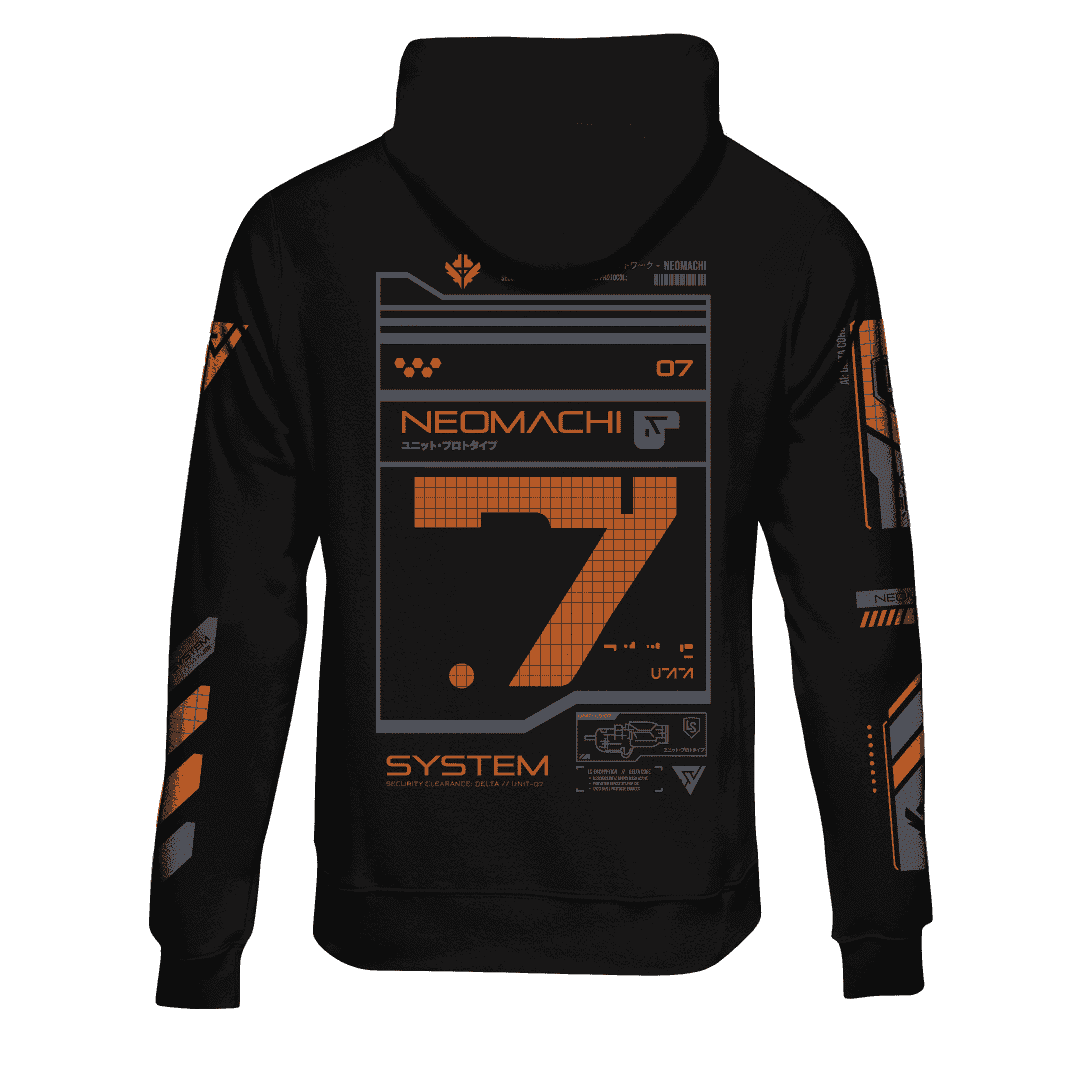
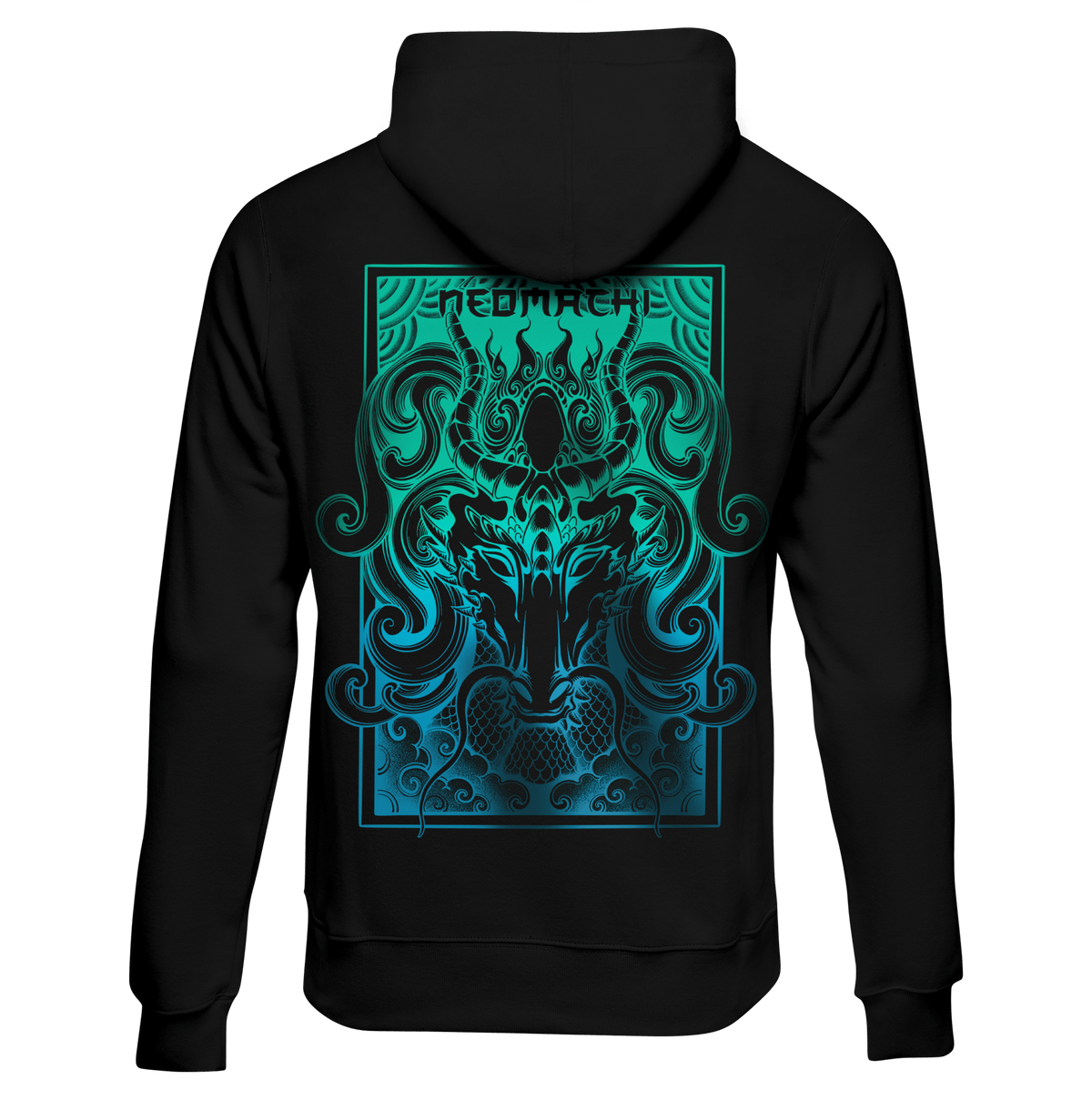
KIRIN is the serene version: the holy beast that walks without bending the grass, glowing through neon and circuitry.
- KIRIN hoodie: B&C Inspire Hooded, 280 GSM, 80% organic cotton with a 20% recycled polyester fleece lining. True to size and slim, so size up for a baggier fit. Our hoodie fit guide has the measurements.
- KIRIN t-shirt: Stanley/Stella Creator 2.0 organic cotton in a medium unisex fit, in black, white or navy.

QILIN is the louder one: the same creature rebuilt with glowing energy cores and biomechanical detail, made for 2026, the Year of the Fire Horse. It comes in the most formats of any design we make:
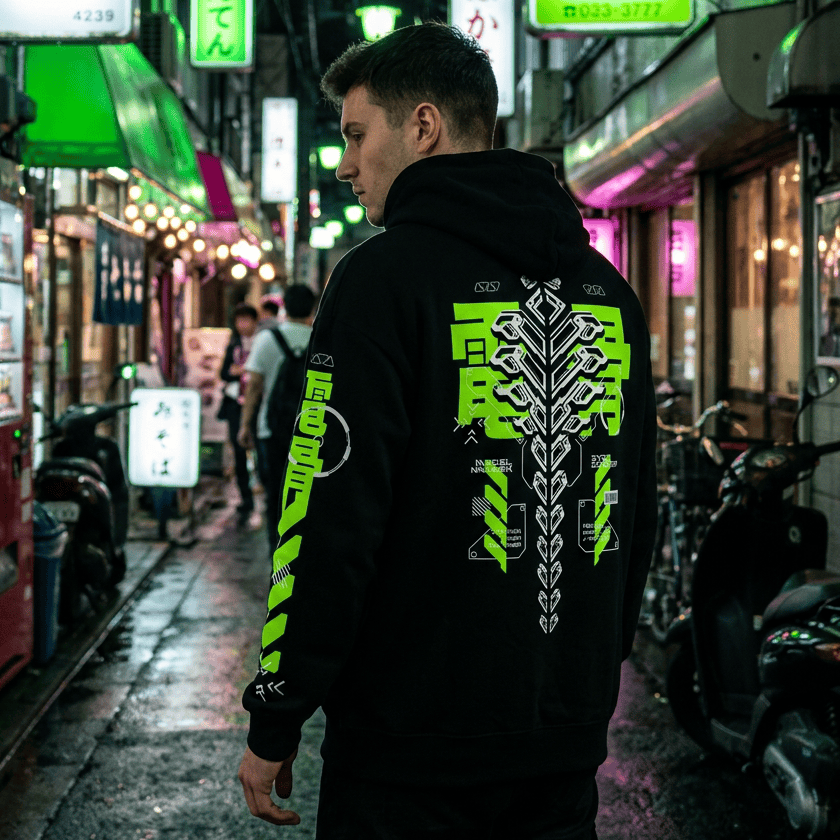
- QILIN hoodie, the everyday piece.
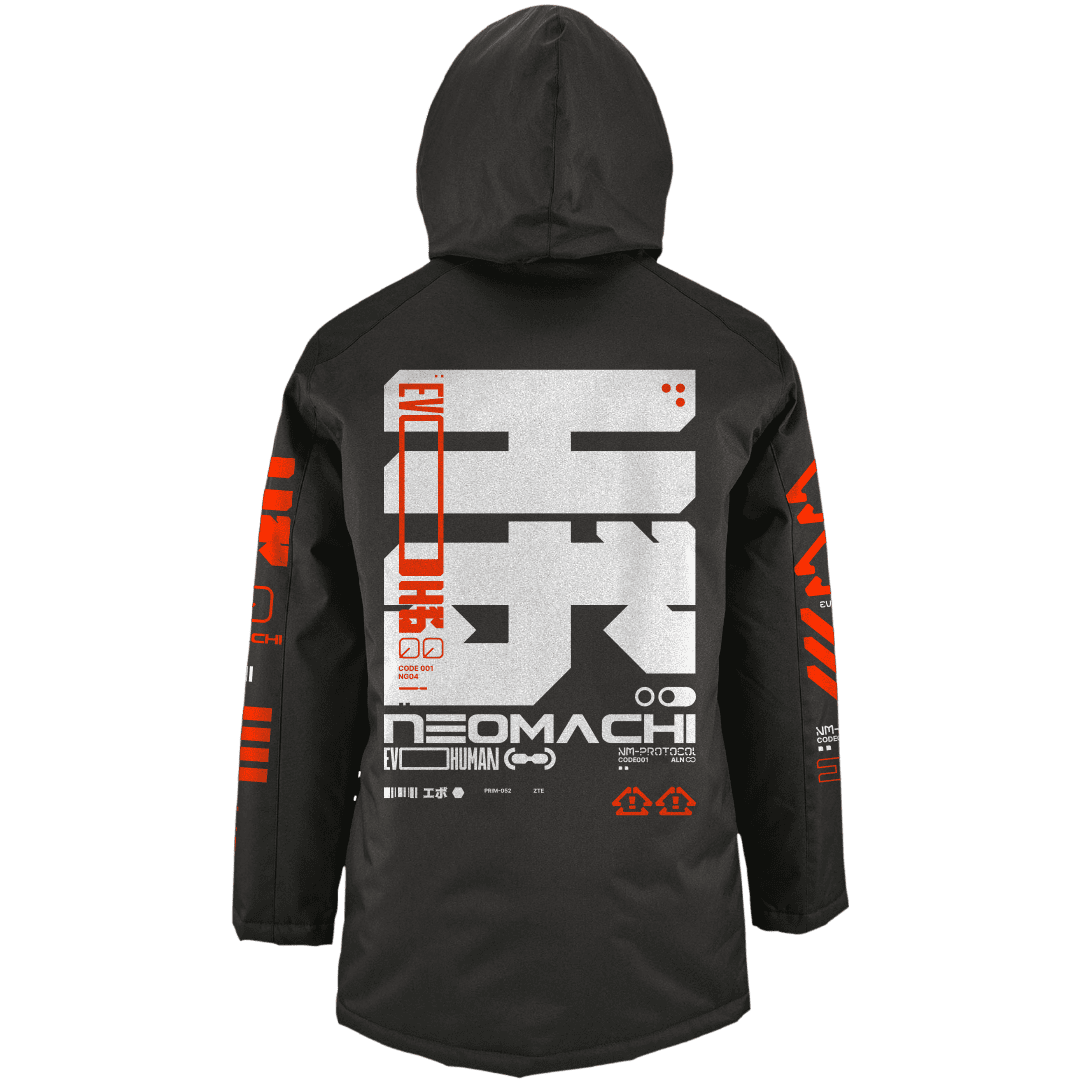
- QILIN parka: water-repellent and windproof, and it runs slightly large, so stay true to size for a relaxed fit or size down for a closer one.
- QILIN premium bomber and QILIN windbreaker for the in-between seasons.

Styling tip: let the creature be the only loud thing. A KIRIN or QILIN hoodie with black trousers and plain trainers reads as streetwear; add more prints and it starts to read as costume. Browse the rest of our cyberpunk hoodies, cyberpunk t-shirts and parkas, or start from the full range of cyberpunk clothing.
Want more of the bestiary? Our guides to the kitsune, oni, akuma and yōkai, the Japanese phoenix, Fujin and Raijin and the wider Japanese symbols and meanings cover the rest of the cast, and the irezumi guide shows how these creatures are used in tattoo art.
Frequently asked questions
What does kirin mean in Japanese?
Kirin (麒麟) is the Japanese name for the qilin, a holy beast of East Asian myth that signals peace, wise rule and the arrival of a sage. In modern Japanese it is also the everyday word for giraffe.
Is a kirin the same as a qilin?
Yes. Kirin is the Japanese reading of the same characters. Japanese art tends to draw it more deer-like and ranks it as the most powerful holy beast, while Chinese art often makes it stockier and places it after the dragon and phoenix.
Is the kirin good or evil?
Good. It is one of the most benevolent creatures in East Asian folklore: it avoids harming living things, only punishes the wicked and appears when a just ruler or great person is near.
Why does kirin mean giraffe?
Because a giraffe brought to China on Zheng He's voyages was presented at the court in 1414 and taken for a living qilin. Japanese and Korean kept the name for the animal.
Is the kirin a yokai?
It sometimes appears in yōkai encyclopaedias, but it is better described as a holy beast or kami than as a yōkai. Yōkai are often tricksters or threats; the kirin is a blessing.