Bōsōzoku fashion, in one line: bōsōzoku (暴走族, "reckless driving tribe") were Japan's teenage motorcycle gangs, and their look was the tokkōfuku, a long embroidered coat or boxy jacket worn open over baggy tapered trousers, boots, a headband and a lot of attitude. And if you landed here searching "baiku": バイク (baiku) is simply the Japanese word for motorbike, borrowed from English "bike", and it is the machine that whole subculture was built around.
Here is where the style came from, what each piece of the uniform actually is, how it fed straight into cyberpunk through Akira, and how to borrow the look without dressing up as a 1980s gang member.

What does baiku mean?
Baiku (バイク) means motorbike or motorcycle in Japanese. It is a loanword, written in katakana like most words borrowed from English, and it is what you would say in everyday conversation: baiku ni noru, to ride a bike. (A bicycle is a different word, jitensha.) In Japan the word carries a bit of extra charge, because for a few decades the baiku was the centre of one of the country's loudest youth subcultures.
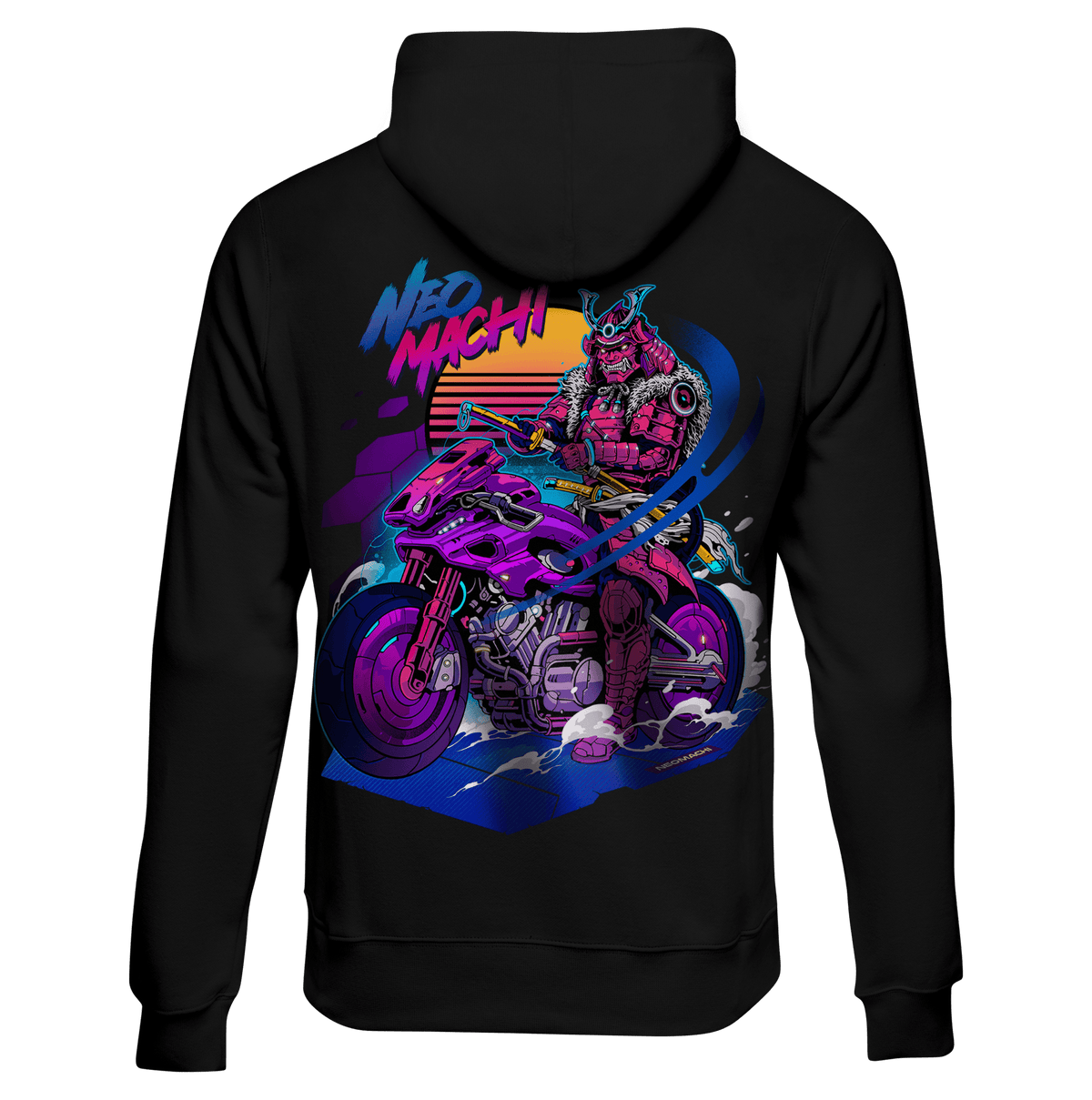
That is also where our BAIKU design comes from: a mecha samurai on a bike, tearing through a neon city at the speed where the background blurs into streaks of light. More on that below.
Who were the bōsōzoku?
The word bōsōzoku breaks down into 暴 (violent, wild), 走 (to run or ride) and 族 (tribe or clan). The groups themselves did not choose it; it was the label the police and press used from the 1970s, a decade of noisy clashes between riders and police.
The roots go back further. In the 1950s, some young men and returning veterans struggling to fit back into post-war Japan took up custom bikes and cars, borrowing heavily from the American greaser image they saw in imported films. By the 1970s and 80s the scene was huge: membership peaked at an estimated 42,510 in 1982, according to police estimates. Most members were teenagers, roughly 16 to 20, who rode in loud convoys at night, often slowly, blocking traffic and running red lights rather than racing.
It was never a harmless hobby. Many groups were violent, and in 2004 a revised road traffic law gave police more power to arrest group riders. Membership fell sharply, to under 7,300 by 2012, and in 2013 the National Police Agency reclassified the remaining gangs as "pseudo-yakuza" groups. What survived, and travelled the world, was the aesthetic: the bikes, the cars and the clothes.
The bōsōzoku outfit, piece by piece
Tokkōfuku: the embroidered coat
The centrepiece is the tokkōfuku (特攻服), literally "special attack clothing". It came as a long coat or a short, boxy jacket, worn open at the front, usually with matching trousers. Early versions were mostly black or white; colour and heavier embroidery spread in the 1990s. Where the cut comes from is debated. One common story links it to work wear worn by labourers; another to the uniforms of Japanese right-wing groups. The name sounds like the wartime kamikaze units, but Tokyo culture magazine Sabukaru, which broke the outfit down in detail, says the two have no direct relationship.
The embroidery is where the outfit talks:
- Chest: usually the area or neighbourhood the member represented.
- Arms: rank and titles, such as sōchō (leader).
- Back: the showpiece, with kanji slogans, four-character phrases, dragons, tigers and flowers. A famous bit of wordplay: 夜露死苦, read yoroshiku ("nice to meet you" or "I'm counting on you"), but spelled with the kanji for night, dew, death and suffering.
Trousers, boots and belts
Below the coat everything was baggy and heavily tapered. There were cropped work trousers, ultra-wide high-waisted tokkō pants, and bontan, customised school trousers cut as wide as possible. They tucked into tall laceless engineer-style boots, or into jikatabi, the split-toe work shoes still worn by Japanese builders and festival crowds. A thick leather belt held it all together.
Headband, mask and hair
The finishing touches were a hachimaki headband, often a surgical-style face mask, sunglasses and a pompadour, the hairstyle Japan calls the "regent". That greaser quiff is the clearest sign of how much the look borrowed from American rock'n'roll films.
The bikes
The baiku mattered as much as the clothes. A typical build started with a 250 to 400cc Japanese road bike and added a multi-pipe exhaust, handlebars pulled in tight, towering fairings angled at the sky, multi-trumpet horns and loud paint. The same over-the-top approach spilled onto cars, which is why "bōsōzoku style" now also means a whole school of wildly modified cars.
Bōsōzoku, Akira and cyberpunk
If you have watched Akira, you have already seen bōsōzoku. Katsuhiro Otomo's story opens with Kaneda and his teenage biker gang ripping through Neo-Tokyo at night, fighting a rival gang on the highway. Kaneda's red bike and jacket became one of the most copied images in the whole genre, and you can trace a straight line from that opening chase to the neon highways of later cyberpunk films, anime and games. We broke down how to wear Kaneda's look in our Akira outfit ideas.
It makes sense. Cyberpunk is "high tech, low life", and the bōsōzoku were the low life of a very high-tech country: teenagers turning mass-produced machines into personal statements and taking over the city after dark. That tension between a rigid society and the rebels customising its technology is a big part of why cyberpunk is so Japanese, and it is why Japanese street style keeps feeding the genre. Our Japanese cyberpunk fashion guide follows the designers who took that energy onto the runway.
How to wear bōsōzoku style today
Nobody needs a ¥300,000 embroidered coat (Sabukaru's estimate for a full custom set) or a convoy. What works in real life is the silhouette and the attitude, translated into everyday streetwear:
- One loud jacket. The tokkōfuku is all about the back. A bomber with a big back graphic does the same job: try the ONI premium bomber, with its Japanese demon, or the KISEKI premium bomber for something more cybernetic. More options in our cyberpunk bombers and the cyberpunk jackets guide.
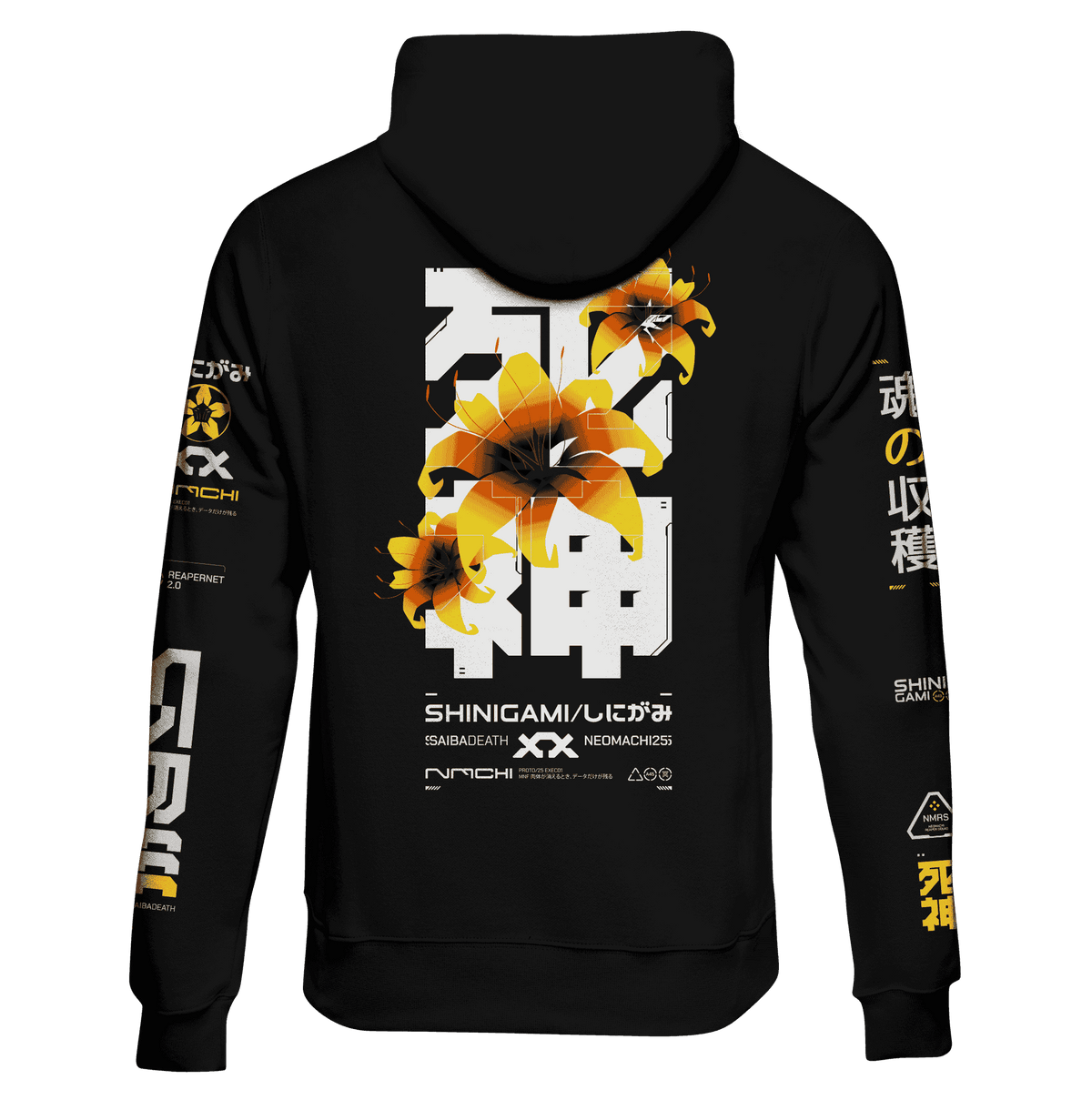
- Baggy, tapered trousers. Wide through the leg, narrow at the ankle. Cuffed joggers like the SHINIGAMI joggers give you the bontan shape without the costume.
- Tall boots, tucked or stacked. Black combat or engineer boots, trousers bunched on top.
- Kanji, but know what it says. Embroidered slogans were the whole point. Wear Japanese text and symbols you understand; our Japanese symbols and meanings guide helps.
- A biker graphic instead of a bike. The BAIKU hoodie or BAIKU t-shirt puts the machine on your back.
One thing to leave out: the Rising Sun flags and the political slogans some gangs used. They carry heavy historical and political weight, especially across East Asia, and the look works perfectly well without them.

Our BAIKU design
BAIKU is our love letter to that night-ride energy: a mecha samurai on a bike, frame in motion, the city reduced to light trails behind him. It sits right where Japanese culture and techwear meet, which is the space all our cyberpunk clothing lives in.
- BAIKU hoodie: B&C Inspire Hooded, 80% organic cotton and 20% recycled polyester. True to size and slim, so size up for a baggier, more bōsōzoku-style fit (see how a hoodie should fit).
- BAIKU t-shirt: Stanley/Stella Creator 2.0 organic cotton, medium unisex fit.
- BAIKU sweater: fitted, so size up if you want room to layer.
Browse the rest of our cyberpunk hoodies and cyberpunk t-shirts for more designs built on Japanese myth and future-city grit.

Frequently asked questions
What does baiku mean in Japanese?
Baiku (バイク) means motorbike or motorcycle. It is a loanword from English "bike" and the everyday word Japanese speakers use for a motorcycle. A bicycle is jitensha.
What is bōsōzoku fashion?
It is the style of Japan's motorcycle gangs: an embroidered tokkōfuku coat or jacket worn open, baggy tapered trousers, tall boots, a hachimaki headband, often a face mask and a pompadour hairstyle.
What does bōsōzoku mean?
Bōsōzoku (暴走族) roughly means "reckless driving tribe": 暴 (wild), 走 (to run or ride) and 族 (tribe). It was a label used by police and media rather than a name the gangs gave themselves.
Do bōsōzoku still exist?
Only in small numbers. Membership peaked at about 42,500 in 1982 and dropped to a few thousand after tougher laws in 2004. Today the style lives on mostly through custom bikes, cars, anime and fashion.
Is Kaneda from Akira a bōsōzoku?
Yes. In Akira, Kaneda leads a teenage biker gang in Neo-Tokyo, and the film's opening highway fight between rival gangs is one of the best-known portrayals of bōsōzoku culture.
NEOMACHI is not affiliated with Akira, Kodansha or any bike maker. All NEOMACHI designs are original artwork. Designed in Amsterdam, printed in Europe. Sources: Wikipedia, "Bōsōzoku"; Sabukaru, "The Fast and the Furiously: Japan's Bōsōzoku".