
Kabuki mask meaning, in one line: kabuki actors don't actually wear masks. The "kabuki mask" is kumadori (隈取), bold makeup painted over a white base, and its colours tell you who a character is: red for a hero, blue for a villain, brown for a demon or spirit.
That is the short version, and it is the one most people searching for a kabuki mask want. But kumadori is one of the best visual systems ever invented for the stage: a face you can read from the back row of a huge theatre, built from a handful of colours and lines. It is also one of the reasons Japanese art keeps turning up on cyberpunk clothing. A face drawn in hard, glowing lines looks right at home under neon.

What does kabuki mean?
Kabuki is written 歌舞伎: ka (歌, song), bu (舞, dance) and ki (伎, skill or performer). Those three kanji are a later, flattering spelling, though. The word most likely comes from the old verb kabuku, "to lean" or "to be out of the ordinary". In the early 1600s, kabukimono were the outrageous dressers and troublemakers of Kyoto's streets. Kabuki, in other words, started as the "weird", avant-garde theatre, which is a fun thing to remember the next time it is described as stuffy and traditional.
The founding story is usually dated to 1603, when a woman named Izumo no Okuni performed new dances with her troupe on the dry bed of the Kamo River in Kyoto. It was a hit, and a scandal. In 1629 the shogunate banned women from the kabuki stage, and from then on every role has been played by men. The actors who specialise in female roles are called onnagata, and it is still an all-male art today. UNESCO recognised kabuki as Intangible Cultural Heritage in 2005 (it was inscribed on the Representative List in 2008).
Is it a kabuki mask or kabuki makeup?
Makeup. This is the most common mix-up. Japan's masked theatre is Noh, which is older (14th century), slower and was patronised by the warrior elite. Noh actors wear carved wooden masks, including the horned, jealous hannya mask. Kabuki grew up later as entertainment for townspeople, and its actors needed their faces to move: to scowl, roll their eyes, freeze into a pose. So instead of wearing a mask, they painted one on.
The "kabuki masks" you see sold as souvenirs and wall decorations are copies of those painted faces. They are a real Japanese craft, but on stage, the mask is the actor's own face.
Kumadori: the painted "kabuki mask"
Kumadori (隈取) roughly means "taking shadows" or "following the contours". The makeup was developed by the Ichikawa Danjūrō line of actors in Edo (old Tokyo) from the late 1600s, for aragoto, the "rough style" of kabuki full of superhuman heroes, huge costumes and explosive anger. Ichikawa Danjūrō I is also credited with the mie, the moment when an actor freezes in a dramatic pose and crosses his eyes, often to shouts from the audience.
The method is simple and strict:
- The face is covered in a white base (oshiroi), which makes it glow under stage light.
- Lines of colour are painted along the muscles and bones of the face, then softened at the edges so they look like veins, tension or shadow rather than stripes.
- The design is symmetrical, and there are more than 50 traditional patterns, each tied to a type of role.
After a performance, an actor can press a cloth or silk sheet onto his painted face to make an oshiguma, a print of the makeup. These are treasured as souvenirs, and they are part of why the kumadori face became an image you can hang on a wall.
Kabuki mask colours and what they mean
This is the part people are really looking for when they search for kabuki mask meaning. The colour of the lines tells the audience what kind of character has just walked on:
| Colour | Meaning | Typical characters |
|---|---|---|
| Red (beni) | Virtue, courage, passion, righteous anger | Heroes, superhuman warriors |
| Blue / indigo (ai) | Evil, fear, jealousy, cold-heartedness | Villains, corrupt nobles, ghosts, fox spirits |
| Brown (taisha) | The non-human | Monsters, demons such as oni, nature spirits |
| Black (sumi) | Emphasis | Used on every type to exaggerate brows, eyes and mouth |
Some guides add purple for nobility and green for the supernatural, but red, blue and brown are the three that do the storytelling. A useful way to remember it: red is hot blood, blue is cold blood, brown is no human blood at all.
The blue and brown roles overlap neatly with Japanese folklore. Shape-shifting kitsune fox spirits often get blue, and the horned oni and other yōkai get brown. Kumadori is, in a way, a colour-coded bestiary of Japan's spirit world.
The famous kabuki face patterns
Suji-guma: the angry hero
The classic. Thick red lines sweep up from the eyes and across the forehead, and fan out on the cheeks. It signals overwhelming power and righteous fury, and is worn by the hero of Shibaraku ("Wait a moment!"), who bursts in to stop a villain just before an execution. If you picture a kabuki face, you are probably picturing suji-guma.
Mukimi-guma: the handsome young hero
Lighter, more elegant red lines for young, dashing heroes, most famously Sukeroku, the stylish swaggering rogue of Edo's pleasure quarters.
Ni-hon-guma: quiet strength
Just two red lines. Calmer, more controlled heroes who are strong without needing to shout about it.
Kuge-are (kuge-guma): the evil aristocrat
A dramatic blue pattern, similar in shape to suji-guma, for scheming court nobles who want to seize power. Same intensity as the hero, opposite colour.
Zare-guma: the comic animal villains
Red lines that turn a face into a monkey, a crab or another creature, used for comic or minor villains.
From kabuki to cyberpunk
Kabuki has fed modern Japanese pop culture for a long time. Its best-loved plot, Kanadehon Chūshingura, is the story of the 47 Ronin. Tokyo's neon nightlife district, Kabukichō in Shinjuku, was named after a kabuki theatre that was planned after the war and never built. Its stacked signs and all-night lights are one of the places the cyberpunk look was copied from, which we get into in why cyberpunk is so Japanese. Night City in Cyberpunk 2077 even has a crowded market district called Kabuki. (NEOMACHI is independent and not affiliated with CD Projekt Red.)
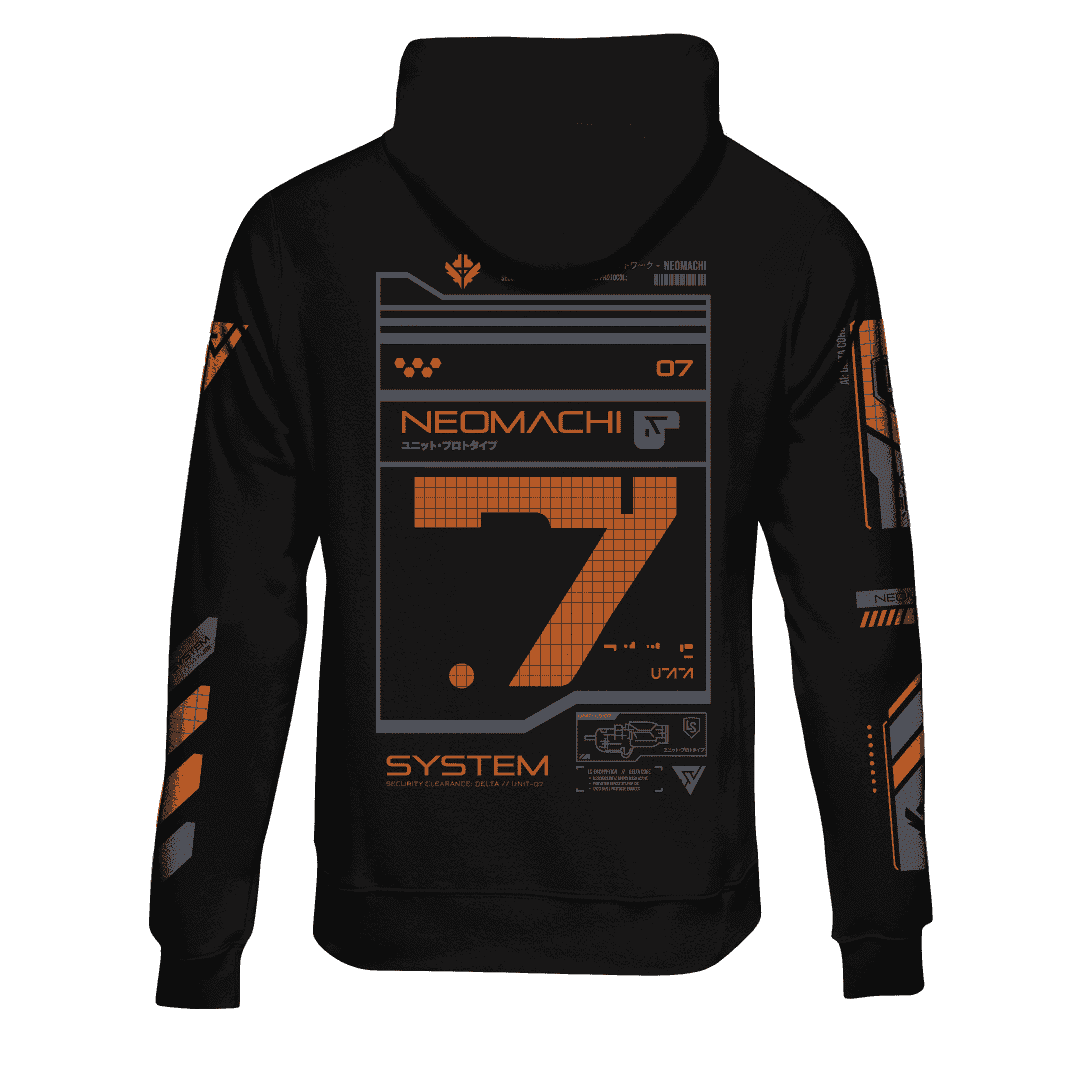
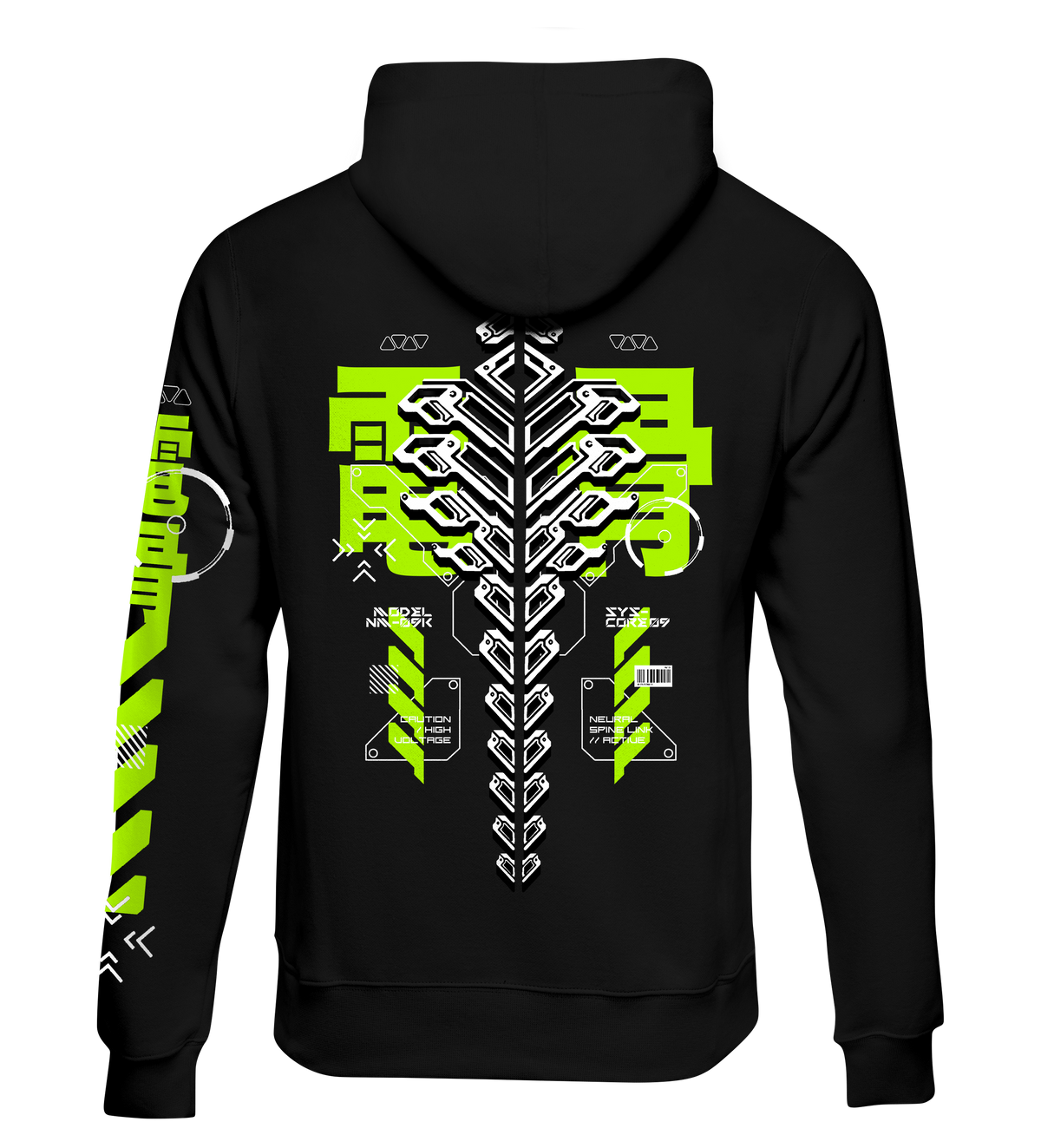
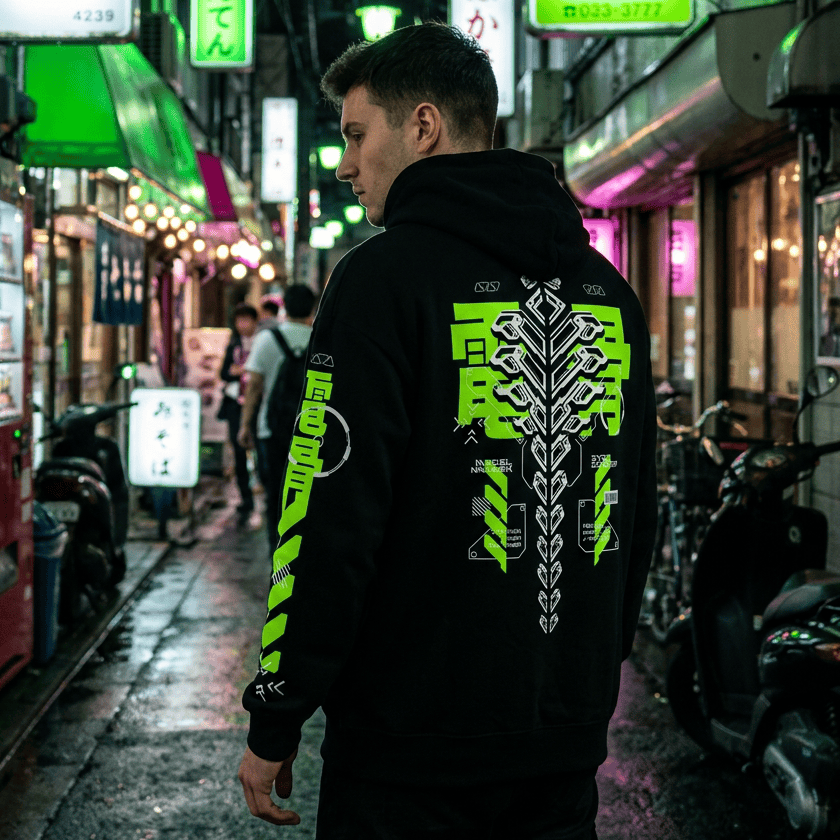
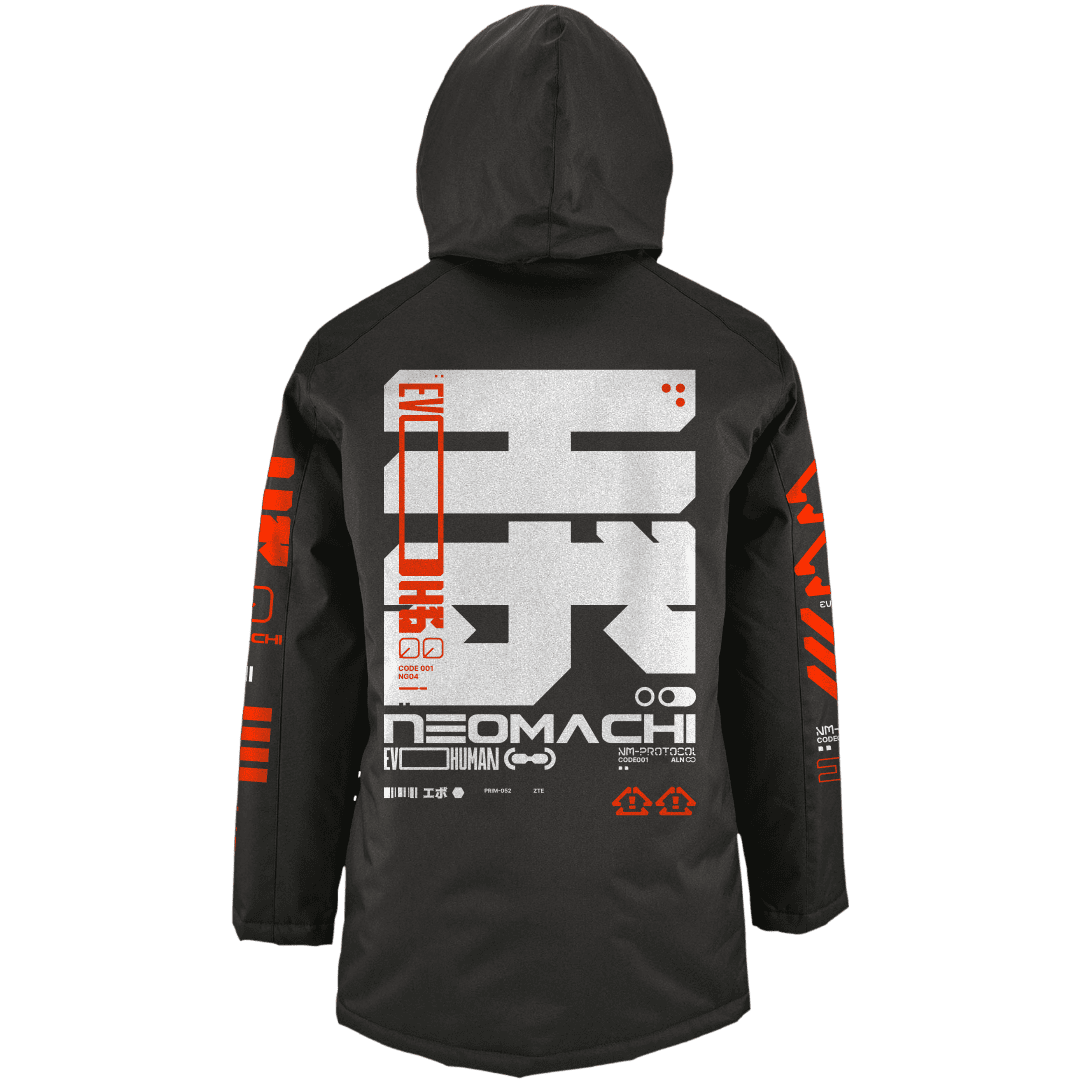
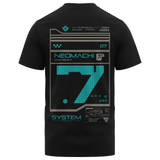
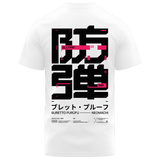
The visual link runs deeper than names. Kumadori is a face made of glowing lines over a pale base, with colour used as a code. Swap the brush for LEDs and you have the face paint and circuit-line tattoos of almost every cyberpunk character design. That is the idea behind our own KABUKI hoodie: a classic kabuki theatre design rebuilt in a futuristic frame by artist Ravo Customs, a shoe artist who brings the same precision to fabric. The same design comes as a KABUKI t-shirt, a sweater and shorts.

How to wear kabuki-inspired streetwear
Kumadori works because everything around it is plain: white face, bold lines. Clothing works the same way.
- Let the print be the only loud thing. A kabuki or mask design on a black hoodie, with black or charcoal joggers and plain shoes, is the whole outfit.
- Borrow the colour code. Wear one accent colour that means something: red for the hero, deep blue if you would rather be the villain.
- Build a cast. Kabuki is full of heroes, demons and spirits, and so is our range. The ONI hoodie is the brown-faced demon, the KITSUNE hoodie (an irezumi-style fox mask by tattoo artist Kishosumi) is the blue-faced trickster, and SAMURAISHA puts a samurai and a geisha in one frame.
- Size for the look. Our hoodies are slim and true to size, so size up for a baggier, more theatrical silhouette. The hoodie fit guide has the measurements.

You can find every design in our cyberpunk hoodies and cyberpunk t-shirts, or browse all our cyberpunk clothing. For more of the figures behind the designs, our guide to Japanese symbols and meanings and the irezumi tattoo guide cover the rest of the cast.
Frequently asked questions
What does a kabuki mask mean?
A kabuki "mask" is really kumadori, painted stage makeup, and its colours show a character's nature. Red lines mean a brave, righteous hero, blue lines mean a villain driven by jealousy or fear, and brown means a demon, monster or spirit.
Do kabuki actors wear masks?
No. Kabuki actors paint their faces with kumadori so their expressions stay visible. Masks belong to Noh theatre, an older Japanese form, which uses carved wooden masks such as the hannya.
What does red mean in kabuki makeup?
Red stands for virtue, courage and passion. It is worn by heroes, from the furious superhuman hero of Shibaraku (suji-guma) to dashing young heroes like Sukeroku (mukimi-guma).
What does blue mean in kabuki makeup?
Blue marks villains and dark emotions such as jealousy and fear. It is used for scheming nobles (kuge-are), ghosts and fox spirits.
What does kabuki mean in Japanese?
Kabuki (歌舞伎) is written with the kanji for song, dance and skill. The word itself probably comes from kabuku, "to lean" or "to be out of the ordinary", so its original sense is closer to "avant-garde" or "eccentric" theatre.